'Twas the night before Father's day and all through the house no-one was stirring, not even a mouse.
Yeah right!
Actually, there was blind panic as two teenage boys realised they had forgotten to act on any of their mother's several reminders and buy a card for their Dad for the morning. The elder one shrugged and said, "I'll make him breakfast in bed: one of my incomparable omelettes, with some filter coffee and fruit juice."
The younger one blamed his mother for not dragging him to the shop by his luxuriant hair. The mother's dulcet voice could be heard in the next county as she gently told him, "Don't you DARE lay this one on me!" She was near to tears as she thought of the hurt her husband would feel as the morning passed without the recognition that, commercial nonsense or not, was more than his due.
Then came the sounds of loud banging from the garage. After some time, the mother went down to investigate. It was getting late and there were neighbours to be considered.
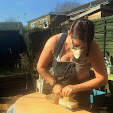
She found her younger son surrounded by bits of wood, nails and a hammer. He had gone scavenging in the garden and found the leavings of the previous owners of the house. These included several tongue-and-groove planks and some rolls of splitpole edging of the type used for garden beds. He used these to produce (taDAH!) a Father's day gift:
His Dad was so tickled with it that he immediately took a photo and posted it on his Facebook page.
Nice save kiddo!
Monday, June 16, 2008
Encouraging creativity

Friday, June 13, 2008
Do they know where to find you?
Hot on the heels of, and closely related to my last post, I recently had a rather odd conversation with a prospective client. I raised the possibility of including user-generated content in a solution we were scoping out. The client wasn't ready to go that route. He was concerned that the material that the users contributed might not be accurate. To illustrate his point, he cited another forum, with several thousand members. One of these individuals had become recognised as the de facto expert on a learning resource which my client's organisation had published. He was... well... miffed. He couldn't understand why the users would go to this man via the discussion forum, rather than coming to the creators of the resource.
I couldn't help wondering: would they know where to find him?
Very few of the learning materials we are asked to develop for customers have "credits". Who designed and developed the materials? Who owns them? Where do you go if you have questions? Who can you speak to?
Well, if you hit your search engine, type in the name of the learning resource and it takes you to a discussion forum with thousands of participants, how much do you care whether any of these people actually wrote/developed/whatever the material?
So, I have a suggestion to make that may seem a bit "Well, duh!" If you want to be the person/organisation people come to when they have questions about some or other material you have produced, then MAKE SURE THEY KNOW HOW TO FIND YOU!
Enter in to the conversation yourself. Be reachable. Be accessible. Be approachable. Make it easy for them.
Not very "if you build it they will come," I know. But there you have it.
The conversation
Some time back, one of my lecturers referred to academic writing as a conversation. She was giving us hints an tips on how to write critical reviews at the time. She explained that no-one ever expects to have the last word or to write The Definitive Piece on a subject, but that each person is adding to the sum of material available on a topic, inviting response from others in the field. She spoke for some time, using words like "conversation" and "discourse" liberally.
This stuck with me, and, when we came to think about our dissertation topics, I came back to these words. You see I like conversation. Those who know me in a face to face capacity tend to describe me using words like chatterbox and motormouth. What they less often appreciate is that I listen enthusiastically and rapaciously as well, and what they relate to me will become part of my portfolio of knowledge, to reappear in a later conversation with someone else. I quite often say things that are aimed at eliciting a response of some kind. I don't mind being disagreed with and set right, just TALK TO ME! I can't learn anything from (or about) people who don't talk.
The trouble with the conversation in its academic format, as I see it, is that it's rather like a conversation between Ents. Any other sad Tolkien bores out there will remember that Treebeard says at one point (in both the book and the remarkably faithful movie) "it takes a very long time to say anything in (Entish), because we do not say anything in it, unless it is worth taking a long time to say, and to listen to."
The academic conversation/discourse is like a series of long, ponderous monologues. Of course, the fact that it can take anything up to two years for an article to be published once it has been accepted by a print publication does nothing to speed things up.
I completely sympathise with the hobbits Merry and Pippin whose frustration knows no bounds when it takes the Ents several days of their discourse to decide that hobbits are not orcs. The poor hobbits are almost hopping from foot to foot with impatience because the Ents have not even touched on what they consider to be far more important matters.
Like Merry and Pippin, I feel small alongside the profound minds that turn out the academic writings I encounter during my research. Like them, I want to interrupt. I want to say, "But what about..?" The only trouble is that, to enter that conversation, I have to observe its rules and learn the language. My but-what-abouts will take two years to appear in print, by which time, other things will have captured my attention. I can almost hear them say it: "Now, now, don't be hasty little Hobbit..."
But there is another conversation going on. One that is far more suited to my impatient, pondskater nature. And that is this one.
You don't have to be an Ent to participate in this conversation. You can be a hobbit, or a man. You can be an orc or an elf. You can be Gandalf or Sauron himself. It doesn't matter. It's open to everyone. If you are an Ent and you want to take two years to think about what you're going to say before you say it. You go right ahead and do that (just don't expect the conversation or the audience still to be in the same place when you get around to it).
So, over here, there is "yes" and "no" and "I agree" and "don't be daft". And over there, there is "hoom" and "A-lalla-lalla-rumba-kamanda-lindor-burúmë".
It's a bit like the difference between playing Scrabble face to face and playing Scrabulous online. But, just as I have learned to do and enjoy both of those things, the challenge for me now is to figure out how to "do and enjoy" the academic approach to the concept of discourse and conversation, so that I can hand in a decent dissertation!
The fact that I have chosen to explore the impact of the use of social media on my professional practice puts me in a tricky position. How do you explain crackle and snap of the speed-of-light, open to all, global conversation using language that "takes a very long time to say anything in it, because we do not say anything in it, unless it is worth taking a long time to say, and to listen to"?
I feel as if I have to deliver live commentary at Wimbledon in an imitation of the style of a medieval balladeer!
Tuesday, June 10, 2008
Service with a smile
One way or another, we are all in the business of customer service. I have my customers. Teachers have their pupils, their pupils' parents and the wider community. Retailers have shoppers, doctors have patients.
Sadly, we sometimes forget the relationship between customer and provider. Certainly I often wonder whether National Health Service providers ever perceive their patients as customers! I have more than once been given cause to think that they view us only as life-support systems for a pathology.
Then, every now and again, you meet someone who bucks the trend and restores the balance. Today I met a new dentist. I would like to make his level of customer service my goal in my dealings with future customers.
A couple of years ago, I broke a tooth. I went to the dentist who told me it would have to be crowned, which would cost me the little matter of £500. Until today, I hadn't been back to the dentist, in spite of being quite particular about my teeth. In spite of a history of 6 monthly visits. I just knew that £500 was hanging over my head like the sword of Damocles and I didn't have it. So the tooth remained broken.
Since we moved house, we have had to attend the things like new doctors (TBC), dentists, hairdressers, service stations.... all that malarkey.
The dentist I saw today took a complete history and checked out my teeth and gums thoroughly. He commended me for my oral hygiene (the secret is TePe brushes, folks, I can't emphasise that enough) and assured me that the broken tooth could be filled for the comparitively bargain basement price of £80. He agreed that crowning was an option but that, if and when I decided to go that route, it would cost £285 because he would make the crown himself with computer-imaging technology. He talked me through the short, medium and long term goals for my teeth and made sure that I was comfortable with all the options available. We made appointments for two fillings (another filling has gotten chipped in the time since my last visit to the dentist) and told me that he would include a free clean in the price.
So...
I know what I'm getting
I know when I'm getting it
I know how much it is going to cost
I know what my options are in the short, medium and long term
I understand everything that is going to happen
My budget has been taken into consideration
My own personal circumstances have been catered to (I can't have local anaesthetic which contains adrenalin or I vibrate like a guitar string - not conducive to precision work!)
Sadly, he's not with the NHS, but at least he will treat my kids free.
Service with a smile... just what you expect from a dentist!
Monday, June 09, 2008
So, whose extension are YOU?
There used to be the most dreadful song called "Barbara's daughter" which included the lines:
Are you Barbara's daughter?To my ear, it represents the worst kind of whining, self-pitying country and western music on the planet. The trouble is, I AM Barbara's daughter, and I do look rather like her (but I don't really have her smile - that came more from my Dad), so people used to sing it to me an awful lot, and I was always expected to react as if it was a new joke.
Are you Barbara's child?
Gee, you sure look like Barbara.
You've got Barbara's smile.
I grow tired of people trying endlessly (and unsuccessfully) to adopt a South African accent, and trotting out phrases with which I am expected immediately to identify because of where I was born.
Have you noticed how people have a tendency to think of other people as extensions? My Dad never knew me (or my sister) as people. He knew us as his daughters. He couldn't have told you a darn thing about either of us as people. If we showed any hint of being unco-ordinated (as teenagers are wont to do) or if we argued with him, he would snap at us, "You're just like your bl**dy mother!"
My younger son gets so tired of having hordes of swooning girls breathily asking "Are you so-and-so's brother?" When I phone the school, I say "It's so-and-so's Mom, here." On the rare occasion that I phone the landline at my husband's office, I identify myself as "John's wife". When my kids bring friends home, they say "This is my Mom/Dad" which is hardly helpful information. On one of our holidays on the tiny Swedish island where my mother-in-law grew up (but left more than 50 years ago), a complete stranger approached my husband and asked "Är du Stina's son?" (Are you Stina's son?).
We seem to spend much of our lives being identified as somebodys' something. Yet I think most of us would dearly like to be seen for who and what we are. My sister once gave me a birthday card that read:
From those who know you, those who love you, and those who know you and still love you.That's what it is, isn't it? We want to be known and accepted (or even rejected) on the basis of who we really are. Not on the basis of some assumption about ourselves as extensions of this or that person, place or thing.
The reason I raise this is that I suggest it is a tendency we need to guard against in our professional capacity. Teachers who teach the younger siblings (and even, in some cases the offspring) of pupils they have taught before sometimes have a tendency to assume that they will show the same talent or otherwise for the subject, that they will have the same tendency to play practical jokes or argue or whatever it may be. A science teacher once told me that she knew the moment she saw my younger son's name on the register for her class that she was in for an exciting year, having taught my older son. Since my younger son never quite aspired to the stellar potential of his brother, the poor lad was set to be a disappointment from the off. Hardly fair!
Are we sometimes guilty of viewing the target audience for our learning resources as being the users of the resource? Thereby reducing them to extensions of a "thing".
When we are developing a learing resource, an approach we often take is to draw up a panel of fictitious people who will use the resource. We give them names, ages, hobbies and interests, family circumstances, etc. and we consider at every stage whether the learning resource is going to meet their needs. They are at the core of the development process.
It's a start.
I'd like to see us find ways to broaden our perception of our learners as people, individuals - even when we are delivering an e-learning solution to an audience of thousands.
Wednesday, June 04, 2008
Well duh! A little something I learned about my car
Perhaps when you read this, you will roll your eyes and say, "Sheesh! Everybody knows that, Karyn!" Or perhaps like me, you will dash out to your car, check the accuracy of the statement and slap your forehead, thinking "After all these years... if only I'd known!" I would certainly like to hear back from you either way. I would also like to hear from you if you discover that this is a load of bunkum.
Anyhoo, this (original author unknown) comes courtesy of my husband (who also slapped his forehead)...
Quick question, what side of your car is your fuel tank? If you're anything like me, you probably can't remember right away. My solution is to uncomfortably stick my head out the window, strain my neck and look. If you don't do this in your own car you definitely have done it in a borrowed or rental car.
Well ladies and gentlemen, I'm going to share with you my little secret so you will no longer look like Ace Ventura on your way to the fuel station or put your neck at risk of injury.
If you look at your fuel gauge, you will see a small icon of a fuel pump. The handle of the fuel pump will extend out on either the left or right side of the pump. If your tank is on the left, the handle will be on the left (image source unknown). If your tank is on the right, the handle will be on the right (Image source: Irish _Eyes). It's that simple!


Tuesday, June 03, 2008
Xenophobia in South Africa
This landed in my Inbox today, shortly after I had responded to Rina's comment on yesterday's post. I can do no better than to add it verbatim here, and share how my heart aches. I'm a ridiculously optimistic person, but even I have entirely lost hope.
By R.W. JOHNSON
FROM WALL STREET JOURNAL EUROPE
May 27, 2008
CAPE TOWN, South Africa
South Africa is taking stock after two weeks of xenophobic riots. By the latest count, 50 people have been killed and thousands injured. Over 600 rioters have been arrested as the violence spread through all nine of the country's provinces. The images are shocking. Large, well-armed mobs of black people rampage through the townships, even the center of the commercial capital, Johannesburg . The necklace (burning tire) style of killing, so familiar from the civil strife that swept the country in the early 1990s, has made a horrific return. The plight of the foreign Africans has been desperate, with some 30,000 displaced and many of their shops and shacks ransacked or destroyed; unknown thousands have gone back home.
The damage to South Africa 's image both within Africa and beyond is very large. Perhaps worst of all, the riots have raised the question of whether the country really made a miraculously peaceful transition from apartheid to multiracial democracy, as so widely trumpeted, 14 years ago. In a ghostly reversal of history, mobs are once more in the streets, and as in apartheid days, the military has been called out to control them. The ruling African National Congress is used to thinking of large, politically mobilized township mobs as masses demanding democracy, and the soldiers out to bring them into submission the instrument of apartheid oppression. Now the roles are reversed, posing some disturbing thoughts about whether one has viewed the past correctly. Certainly the sight of workers attacking workers is a nightmare for the left. The greater fear is that this could all easily spill over into intra-South African tribal conflict.
Nobody knows how many illegal immigrants there are in South Africa . Most estimates suggest that up to four million Zimbabweans have fled here from Robert Mugabe's rule of brutality and enforced poverty. Mozambicans make up the second-largest group. But South Africa 's borders are porous and there are also large numbers of people from Malawi, Nigeria, the Democratic of Congo , Somalia and elsewhere in Africa. At a bare minimum there must be five million such illegals, though some think there are twice that number. Xenophobia is not new -- over 30 Somali shopkeepers were murdered in Cape Town in the last two years -- but the country has not witnessed civil strife on anything like this scale before.
The causes are obvious. A Markinor survey earlier this month found that only 42% of South Africans had jobs. Millions are housed in shacks lacking many basic amenities. It is now winter here and at night on the Gold Reef, on which Johannesburg was built, temperatures can fall below freezing, so the homeless can no longer live on the streets. In addition, soaring food prices and shortages of maize, the African staple, have left many hungry. Tempers have frayed and many point to foreigners as a major source of crime.
But the greatest complaint, inevitably, is that "They are taking our jobs." There is some truth to this: Employers generally find Zimbabweans and Malawians make desirable employees -- they are often better-educated, speak better English and work harder. In my little valley in Cape Town every single domestic servant or gardener is now from one of those two countries.
Some are political refugees from Mugabe's Zimbabwe but mainly they're economic migrants, drawn by South Africa's more developed economy. South Africa's per capita income is, for example, 36 times Mozambique 's.
Thabo Mbeki's government has floundered in response, clearly unaware that it has been sitting on a powder keg for some time -- despite warnings from African ambassadors here. Astonishingly, President Mbeki has failed to visit any of the trouble spots or even vary his program of frequent foreign visits. This has merely added to the general impression that the disaster is due to the government's having allowed everything to drift -- it simply couldn't be bothered to do its job. It failed to exercise immigration control; halved the number of riot police; abolished the rural commando system that used to patrol rural areas; propped up Robert Mugabe's regime in Zimbabwe, causing millions of Zimbabwean refugees to flee to South Africa; and did too little about jobs and housing for locals. Above all, in its pan-Africanist naïveté the Mbeki government assumed that all Africans are brothers. It failed to realize that to allow uncontrolled and massive immigration into a society already overflowing with unemployment is inevitably explosive.
The government has been frantically trying to suggest that right-wing whites or Chief Mangosuthu Buthelezi's Inkatha movement are behind the attacks. This is ludicrous. Chief Buthelezi has in fact distinguished himself in this crisis. He is the only major black leader to tour the trouble spots, to commiserate with the refugees and apologize to them, and to sternly threaten that any of his supporters who join the rioters will be expelled from Inkatha.
ANC leaders have preferred to give homilies, from a safe distance, about how when the ANC was in exile they received hospitality from many African countries and everyone must accordingly treat other Africans as brothers now. This fails to understand the difference between a country hosting a few thousand ANC exiles and the competitive impact in the labor, housing and other markets of millions of illegal immigrants.
The government has treated the problem as one of xenophobia only, as if it is all about people having the wrong ideas in their heads. The underlying causes have not been tackled and there is no sign that they will be. In its pan-Africanist enthusiasm the government has now signed a protocol allowing free movement of people within the 15-nation Southern African Development Community. When this comes into effect shortly, many million more Mozambicans and Congolese could well attempt to move to South Africa. Apostles of African unity like Mr. Mbeki cannot see why Africa should not follow the example of the European Union. In effect the street mobs are demanding the opposite. Further collisions can hardly be ruled out.
Mr. Johnson is southern Africa correspondent for the Sunday Times of London.
Monday, June 02, 2008
True greatness from Paderewski
A musician friend of mine in Cape Town sent me this story today:
Wishing to encourage her young son's progress on the piano, a mother took her boy to a Paderewski concert. After they were seated, the mother spotted an old friend in the audience and walked down the aisle to greet her.When I think of how the great master might have reacted - what a hissy fit many great artists might have thrown - I am amazed. There's a lesson in there for all of us... and I won't patronise you by spelling it out!
Seizing the opportunity to explore the wonders of the concert hall, the little boy rose and eventually explored his way through a door marked "NO ADMITTANCE."
When the house lights dimmed and the concert was about to begin, the mother returned to her seat and discovered that the child was missing.
Suddenly, the curtains parted and spotlights focused on the impressive Steinway on stage. In horror, the mother saw her little boy sitting at the keyboard, innocently picking out "Twinkle, Twinkle Little Star."
At that moment, the great piano master made his entrance, quickly moved to the piano, and whispered in the boy's ear, "Don't quit; keep playing." Then, leaning over, Paderewski reached down with his left hand and began filling in a bass part. Soon his right arm reached around to the other side of the child, and he added a running obbligato. Together, the old master and the young novice transformed what could have been a frightening situation into a wonderfully creative experience.
The audience was so mesmerized that they couldn't recall what else the great master played. Only the classic, " Twinkle, Twinkle Little Star."
Sunday, June 01, 2008
On not being Gretzky
Today I went to watch my husband play ice hockey for the first time in a long time. The occasion was a now-traditional memorial fixture between his team and a favourite rival. A few years back, while returning from a game against my husband's team, a member of the opposition was killed in a car accident. Since then, every year, the two teams meet for this game over and above the usual fixtures which see them facing off against each other.
It needs to be mentioned that my husband plays for a recreational team of ... ahem... more mature players. The rules are adapted accordingly or they would spend a great deal more of their time recovering from injury - especially since they don't trouble themselves with such minor issues as "hockey season". They play all year through!
What I saw today was:
- some guys with the head knowledge of where they needed to be and what to do when they got there, but no longer possessing the speed to get there in time (my husband falls into this category)
- others who lack the instinct to transfer the drills they practise to the game - utterly devoid of a hockey brain, but out there trying their best
- some who had learnt to play the game too late in life ever to master the techniques needed to be able to play with any degree of aplomb
With learning technology developing as fast as it is, and new apps appearing and disappearing at an alarming rate, I often feel that I am doing pretty much what my poor husband did this afternoon: that it is all I can do to chase the puck endlessly, knowing full well that by the time I reach the place it's currently headed, it will have gone somewhere else!
While I have been playing the learning game as a professional for a long time, now, I still lack the ability to state with confidence where the game is going (to the extent that I chicken out of the round of "annual predictions for the year ahead posts"). All I have to hope is that, when the puck and I find ourselves in the same space at the same time, whether by good luck or good management, I prove to have some skill with it!
One thing I do know. When I finally stagger off the ice and into retirement, I will be wrung out and panting, but exhilarated. I will know I gave it my best shot and that it was one hell of a game!
Wednesday, May 28, 2008
Twenty years, and still going strong

It would come with rockets, bells and poetry
But with me and you, it just started quietly and grew
And believe it or not
Now there's something groovy and good
'bout whatever we've got
And it's getting better
Growing stronger
Warm and wilder
Getting better everyday
(Mama Cass: It's getting better)
 Looks like we made it
Look how far we've come my baby
I'm glad we didn't listen
Look at what we would have been missing
They said, "I'll bet they never make it"
But just look at us holding on
Still together, still going strong
You're still the one...
(Shania Twain: Still the one)
Assessment must assess!
I am busy with a project at the moment, on which a bit of a sticking point has developed around the assessments. Some of the assessment questions being forward are, well, inappropriate.
One could argue (and I often do) that the most valid form of assessment is the performance management process. One's team leader and colleagues will be best positioned to assess whether your learning has resulted in any changed behaviours, increased skill, etc.
But there are times when compliance requirements must override such intangible evidence, and quantifiable evidence must be recorded. This generates the need for assessment.
Matters are not helped by the fact that the word that has passed into common parlance (thanks to the terminology used in the various applications) is "Quiz". It's hard to place much credence on an assessment that is termed a quiz, but it is what it is, so we'll move past that point.
The expectations of SMEs and sponsoring clients (and now I'm not just referring to my current project) seem often to be for multiple choice questions that are lifted straight from the text of the learning resource.
If it is possible for a person with no prior knowledge of a concept to take the assessment and pass, then I'd question the validity of the assessment. If the question is followed by a reference to page on which the answer may be found, even more so! At the very least, the questions must call for inference. Primary school children do comprehension tests on extracts from literature, where the answers may be found verbatim in the text. Once they get to secondary school, children are expected to be able to draw conclusions and to conjecture based on the given text. Why, when we're dealing with work-based adults, do we feel the need to revert to the verbatim approach?
We should be able to say with confidence that passing an assessment is indicative of something. Based on the fact that Joe Bloggs has passed this assessment, I should be able to assume that he has a good working knowledge of whatever-it-is. If this is not the case, then surely the assessment is a waste of time and resources.
When there is a compliance requirement for an assessment, this usually means that there is a regulatory body in the background. Let's imagine that a representative of this body is visiting our site. Proudly we tell him/her that 97% of our staff have passed the assessment on, say, first aid in the workplace. The rep asks to see the assessment.
Q1. Do you know where the first aid kit is kept?
(a) Yes
(b) No
(Correct answer: yes)
Q2. The position in which we place a person is known as:
(a) The pike position
(b) The first aid position
(c) The missionary position
(d) The recovery position
(Correct answer: d)
I can't imagine that this will fill the rep with any sense of confidence that, were he/she to take a tumble during that visit, any number of employees would be able to provide appropriate first aid. In fact, perhaps it is worth mentioning that I have a certificate that says I am a qualified first aider, yet I faint at the sight of blood - surely the assessment should have taken this small impediment into consideration?
I would also argue that a straightforward multiple choice assessment has limited validity. There are all manner of urban legends that tell of small children/monkeys/random generators that pass such assessments. All these aside, there are limits as to the challenge that such questions can present. Although it is worth bearing in mind that, with the technology at our disposal, there is much that we can do with multiple choice - instead of four text options from which to select, the user might be faced with images, video/audio clips or cartoon strips.
The trouble with assessment questions that go beyond "select the correct answer" is that they are likely to require some human intervention. Even if the answers are a couple of lines of text, someone will have to "mark" them, since the automated options are a bit thin and unreliable on this front. And this is where the rope hits the rudder. Quite often, elearning resources are requisitioned to obviate the need for human involvement in learning and development. I have lost count of the number of times I have suggested a project-based learning-cum-assessment to be submitted to the line manager within a specified timeframe, only to be assured that (a) the learners wouldn't do it and (b) the line managers would never agree to it.
Sigh.
Let's look at it this way:
- Do you really need a formal assessment? If not, skip it!
- Why? Your justification of your requirement will shape the assessment.
- How will it benefit the learner? And yes, this is the point... unless of course, this is purely a box ticking exercise.
- What do you want it to prove? What conclusions should I be able to draw from each person's results on the assessment?
And above all, it must be possible to fail. If you have created an assessment that anybody can pass then what you have is not an assessment at all. It is an attendance register.
Tuesday, May 27, 2008
Who are "their own people" anyway?
You may be aware of the horrific things going on in South Africa at the moment.
For years, the South African unemployment rate has been sky high. Few of the local people believe the official figures and most believe the real figure to be at least 40%. For some time, Zimbabweans have been streaming in to South Africa, to the point that some sources say that there are more Zimbabweans outside Zimbabwe than inside (although the DFID gives a somewhat less extreme figure).
With violence, poverty and famine spreading across the rest of the continent, a growing tide of refugees is flooding in to South Africa from all over Africa, some from as far north as Somalia.
Forgetting that many of them are themselves the offspring of migrant workers from neighbouring countries, some South Africans have begun perpetrating the most astonishing crimes against immigrants. Some have taken to dragging refugees out into the streets and setting them alight.
As with many South Africans abroad, I increasingly find myself on the receiving end of a barrage of questions. As if I should have some insight into this sort of behaviour. I do not. But do people not realise the extent to which it betrays bigotry to ask (as far too many do), "How can they do this to their own people?"
In what way are these "their own people"? If there were to be an act of violence perpetrated by a gang of English thugs against a German family, or an American gang attacked a family of Canadians, would we ask how they can do this to "their own people"? I think not.
Simply because both perpetrator and victim happen to be black does not make them one another's "own people". In the western world, there seems to be this perception of Africa as a single nation. It is not. It is many nations, within which there are many, many tribes. These tribal bonds are often stronger than the national ones.
When discussing the British Empire's role in the slave trade, many people will mitigate the blame by pointing out that it started with Africans selling "their own people" into slavery. Once again, it was not "their own people" who were being traded, but the members of conquered tribes and nations.
I hate to sound as if I'm lecturing (perhaps I am), but the phrase "their own people" is not a million miles from "they all look alike to me".
I am not for a moment condoning or excusing this behaviour. Quite the reverse. But when deploring the violence, let's have an informed debate and not undermine our position by demonstrating bigoted ignorance.
I'll get off my soapbox now.
Sunday, May 25, 2008
The down side of good manners
Rant warning - this post has little or nothing to do with learning, but is the outpouring of a heavy heart.
Featuring understandably big in the news in the UK at the moment is the story of a little girl who died of what appears to be starvation in Birmingham. Her 5 siblings were found to be emaciated and underfed. They were taken out of school, after their mother said they were being bullied.
There are few incidences of below-the-breadline poverty in the UK, so it seems unlikely that the parents could not afford to feed their children. Which would seem to indicate that it was their choice not to feed them. Perhaps their reasons will be made known during the course of the investigation.
Naturally, fingers are pointing at social services who allegedly only made one call to the house, finding no-one home, and did not return. The children's father, with whom they were no longer living, has called the situation a disgrace. I yelled at the telly, "Yeah, and where were you?" My husband reminded me that he may not have had access to his children (this is not an unknown situation - we have a very close friend who is still fighting to be allowed to see his twin daughters after their mother walked out him when they were just tots. They are now adults and one is married.)
And yes, if the story is what it appears to be at face value, these children have been failed by their parents and by social services.
But there have been accounts from the neighbours of how these children were so hungry they would take food left out for the birds. And yet these neighbours did not intervene. You see, that would have been rude. Interfering in one another's lives has become taboo in our western culture. "It's none of my business, you see." So we watch from a distance while children die of starvation, neglect and abuse. We tut to each other about the evidence we see of these situations, but we take no action.
I wonder. If my neighbours' stick thin children were "stealing" the food that I put out for the birds, would I not suddenly take it into my head that what the birds really needed to eat was peanutbutter sandwiches? And bananas? Would I not seek to befriend these children and invite them in for the occasional protein drink? Would I not notify the police? Would I not call social services repeatedly until they took action to shut me up? Would I not overcome my reluctance to interfere and try to speak to the parents?
Whatever became of the village it supposedly takes to raise a child?
We're so very quick to storm outside and tell the kids to pipe down when they play raucus games in the street. We aren't afraid to go and knock on the neighbours' door to tell them we're had about enough of their son's loud music. We have no qualms about asking them please not to drive over our lawn. Let them inconvenience us and we will take action.
And yet, under our very noses, in our nice, affluent, first world neighbourhoods, children are being beaten, starved and abused... and sometimes we know about it!
There's a girl in my neighbourhood. She looks to be about 12. She doesn't go to school. She appears to have no friends but her cat. I have never seen her with any parents. I have never seen her smile. She spends hours drifting aimlessly around the nighbourhood on her scooter or sitting on a low wall outside her house, stroking her cat.
I worry about her, and yet I have done nothing. I can't for the life of me think of a valid excuse to go and talk to her. I tell myself to go and talk to her. Then I tell myself it's none of my business and perhaps she's just being homeschooled.
I am so angry with those neighbours whose inaction contributed to Khyra's death. But I am no better.
Mea culpa.
Thursday, May 22, 2008
Second Life et al
Right at the outset, let me say that I have yet to be in an environment with enough bandwidth to be able to make Second Life a viable option for me. I have also yet to meet a client with the appetite for a solution which might involve delivery via SL.
That doesn't change the fact that I am deeply curious as to where it might go. and what it might have to offer. These thoughts bubbled up again today after I read Mick's post.
As I said in my comment on his post, it is important to grasp that SL is not a “computer game”. It’s a platform. People who go there and expect exciting things to happen are missing the point. After all, you don’t go to town and then sit around there waiting for things to happen. Nor do you go and drift aimlessly wondering what the point is of being there. You go because you have some fixed objectives in mind.
When the same is true of SL, it makes more sense. If you’re attending a meeting, visting an art gallery, attending a seminar, etc. you have a goal and a purpose and SL becomes the platform by which you achieve it.
Having said that, I see no point in using this new wineskin for old wine. Why use SL to deliver a traditional classroom-based, teacher-led, chalk-and-talk session? Instead, you could have a dispersed team from around the world carrying out a project together and learning as they go. You could have simulated scenarios that can’t be recreated in the physical world for whatever reason, and use those for learning. I have been told that there is a teaching hospital in SL, where patients with predetermined conditions await treatment by student doctors and nurses. Obviously, in the physical world, there is the risk of patients dying or suing. This risk is mitigated in a virtual environment.
I suspect that what people tend to do is to say: "This is what we've always done, let's do it via Second Life, because that will be sexy." Instead, I suggest we should be saying "This is what we want to achieve, is there some functionality in Second Life that will help us get there?"
And, yes, Second Life has been around for a while, now, but it is still a fairly fledgling technology. There are teething problems. The direction these technologies develop in can be dictated by their users. If we start making demands of it, start pushing the envelope in this or that direction, it will have to evolve to keep up.Think about it this way: we can have a say in what virtual worlds become by dint of the magic words "I want..." This is what I suspect is happening with the Wii.
Wednesday, May 21, 2008
My reputation precedes me!
Yesterday I attended a design meeting for a new project. It is in its early stages at this point. The client contacted me and asked if I would attend. Apparently the author/SME had asked for me. We had worked together on a previous project, and he felt that the working relationship had been positive. He couldn't remember my name though. Instead he referred to me as that "bossy woman from L&D".
So, if you hear anyone talking about needing someone bossy for an L&D project, it's probably me they're after.
Let them know where they can find me.
Friday, May 16, 2008
NOT teaching to the test
It's exam time here in the UK, and of course, a lot of airtime is being given to this or that expert and this or that kid with an exciting viewpoint to present. The latest two I heard today were (1) that an expert has pointed at the currect system of assessment cannot be truly even handed, since each marker will interpret an answer slightly differently, and that (and this is the kicker) this meant that the assessment system was not a completely reliable picture of a child's abilities in a subject (gee wow!) and (2) that a kid is complaining that their high school education is so focussed on the final assessment that they're not actually getting a worhtwhile education.
We have been thoroughly embroiled in exams with our elder son taking his GCSEs and our younger one doing his key stage 3 SATs.
Interestingly, I have discovered (just today) that my elder son's music teacher has not been one of those that the aforementioned kid was complaining about. The music class has spent the most wonderful year doing all sorts of practical things, and learning blow-all theory.
A couple of weeks ago, as is the wont of teachers at this stage of the final year, the teacher set the kids the task of completing a previous year's GCSE paper. My son apparently scored the highest mark in the class... a magnificent 45/120. Looking at the paper afterwards, the teacher's reaction was, "Hm. I haven't taught you any of this stuff."
So it seems he ignored the curriculum and did his own thing with the kids. Hence the enjoyment of the class. However, if any of the kids want to continue with music into the 6th form, they don't stand a chance of being accepted to do so, because they won't have achieved suitable results.
So where does this leave us?
You teach to the test and the kids learn little they can apply or you don't teach to the test and the kids don't get to carry the subject over to further education.
Surely there must be another way?
Sadly, I suspect it means completely overhauling the education system, not just tweaking the existing one. It means throwing away everything we think we know about assessment and starting again from scratch. Which means, as far as I'm concerned starting with the premise: what do we want to be able to say of a properly educated 18 year old, how do we get them there, and how do we tell when whether we've succeeded or not?
I'm not going to hold my breath!
As it happens, my son has no desire to take music for his A levels. He has chosen Physics, Chemistry, Biology and Maths (talk about putting all your eggs into one basket!). The tradition is to take 4 subjects for the first year (AS levels) and then drop one, so you finish with 3 A levels. He wants to keep all four going.
I hope he's going to get better support than the "teaching to the test" approach. Much as I deplore the system, I also hope he's going to receive teaching that will enable to him to face the exams feeling that he's on familiar ground. If he's to succeed in his goal of getting into Bristol University to study forensics, he's going to need to play the system.
Sigh.
So, how did you get started... and what difference has it made?
For my dissertation, I'm exploring the impact of the use of social media on the professional practice of learning professionals. To the consternation of my rathe rconservative university, I am submitting the dissertation in the form of a wiki (although - strictly speaking - is it really a wiki if I don't open it up to the community to co-author, which of course I can't do in this instance).
Be that as it may, I'd like to know your story.
- How did you get started with social media?
- What was your introduction, and how did the journey unfold?
- What difference has it made in your professional practice?
Note: I will regard your submission as inclusive of assent for its use in its entirety, or in part in my dissertation. The url for this post, or for the post you create/indicate will serve as the reference.
I'd be especially appreciative if you'd point your readers in my direction, too, since I suspect I'm only reaching a small group here!
Wednesday, May 14, 2008
If I had a hammer...
Mark Berthelemy addresses one my key concerns about the proliferation of rapid elearning materials.
I have seen some pretty dire PowerPoint presentations posing as learning materials in my lifetime. The thought of these perpetrators authors - being able to sex these things up and get away with inflicting them on learners for even longer...
Silk purse, anyone?
You gotta have mojo
I've lost my mojo. Last seen hightailing it out of the door of my office towards the end of March this year. If anyone sees it, please return it to me c/o The Learning Doldrums.
Since I escaped the tyranny of the formal education system (with apologies to all you wonderfully dedicated, overworked, underpaid teachers), I have been the most driven, self-motivated, passionate learner I have ever encountered. I love knowing new things.
But a strange thing happened to me on the way to an MA award which served to remind me of the importance - nay criticality - of one characteristic of the successful learner: motivation.
Because I want to know stuff, I process it and assimilate it at an alarming rate. Because I want to remember people's names, I can match more names to faces than most people I know. Because I want to. Because I am motivated.
Usually.
Then, just before we left for our holiday in South Africa, I finally received the results of an independent studies paper I had submitted in January. The university commits to returning results within 4 weeks of submission. It had taken 8 weeks for these to come back, during the last four of which I had made a pest of myself with repeated emails and phone calls, requesting my feedback.
I had failed!
I had never failed an assessment in my life. I even passed my driving test on the first attempt. It's true to say that I scraped through history in high school by the skin of my teeth, but I did scrape through. This time I had failed. Failed, I say!
The feedback said that I had submitted what read like a lively presentation but did not qualify as a piece of academic writing. Also, I had not cited enough references.
I felt hollow. Deflated. And it was at that moment that my get-up-and-go got up and went.
You see, other than the independent studies module, all that remained was my dissertation. As I began writing the IS paper, it dawned on me that I was doing very well on my MA programme. I had passed all but one paper with merit or distinction. I realised that I stood a chance of coming out of this with a merit, maybe even a distinction overall! Wow! What a thought for a girl who had to wheedle her way onto the programme without a B degree. I decided I might as well give it a shot. So I figured it out. If I scored 82% for the IS paper, and got a distinction for my dissertation, that would give me an overall distinction.
I worked harder on that paper than all my others put together. I put in far more work than a 3,000 word essay warranted. I was pretty sure I'd get at least a merit, probably even a distinction, but would I hit that magic 82%?
Erm... no.
To make things worse, I had chosen to do a case study on a failed project (looking into whether it had failed because corporate trainers don't know enough about learning). Because it had failed, the staff had been re-deployed. Some had moved out of the business altogether. A rewrite was out of the question. Also, a rewrite would garner me a "pass" at best. No merits, no distinctions.
I was astonished at the extent of my demotivation. Not only did it impact the module I had failed, but it spread to the dissertation as well. It has been nearly two months, and I haven't touched it. Not a word.
I'm really struggling to pull myself together to care. In my head, I know I want to finish this. But my heart just isn't in it.
I know we tend to pooh-pooh old Bloom and his domains, but let me tell you that the affective domain has overridden the cognitive in this instance, even though the cognitive is trying to fight back.
Maybe you've got some learners who've lost their mojo, too. Maybe they need a little help getting it back. But don't give them mine! I need that back, please.
Tuesday, May 13, 2008
Need I say more?
Just recently, I had a conversation with a client. It went as follows:
Client: "Is it possible to make it so the user can't see the assessment until they've finished all the modules?"I am adamant that, if a person already demonstrates competency in a particular area, in accordance with the criteria set by the regulatory body, there is no reason to waste their time (and consequently the organisation's money) by forcing them to plough through material that they already know.
Me: "Why would you want to do that?"
Client: "Well, because otherwise they might just do the test and pass, and then not do the modules."
Me: "Why is that a problem?"
Quite apart from which, consider the impact that this will have on the person's attitude towards learning resources in the future. As if we don't have enough of an attitudinal barrier to overcome as it is.
Please, please, please... let's remember that, in the field of corporate learning, we are dealing with grown-ups!
Friday, May 09, 2008
The lost generation... there is hope
This is both clever and heart-stirring. Thanks to Lynn Wernham for the link.
Are you famous?
When they left the Learning Technologies conference in January, Jay and Jane were struggling up the stairs at the station with a heavy bag. I was torn. Should I abandon my own bags on the platform and go and help them? Fortunately, I was beaten to the punch by a teenage boy who separated himself from his gaggle of friends and went to their aid. He returned to a chorus of gentle teasing from his friends and announced "He called me a gentleman and a scholar."
To save him from the teasing of his friends, I asked if he knew who Jay was. When I was met with blank looks, I gave them a potted history. "So is he famous?" one of them asked.
Good question. Is Jay Cross famous?
I have said before that I don't do star struck. I have met enough "stars" in my life to know that we all use loo paper for the same purpose and there are too many people who think that famous= superior, which it most decidedly does not. I once cause dismay and consternation by treating Lord Someone-or-other, former secretary of
Many years ago, my niece once made a throwaway reference to her "famous aunt". That would be me. I asked her what on earth had given her the idea that I was famous, to which she replied, "Everyone knows who you are." She had lived all her short life in a small town where I had once been a prominent member of the amateur dramatic society. In my prime, I tended to play some pretty hefty parts, and sang at my fair share of weddings. Then I left and moved to
So I don't gush over movie stars and musos. And I have no appetite for people who are famous for being famous. During an infamous confrontation in Celebrity Big Brother (what a dreadful programme!) some time ago, the Bollywood actress Shilpa Shetty - at the time a bigger star than than Hollywood's Cameron Diaz, according to some sources - was denigrated by one of the other contestants, Jade Goody, for having delusions of grandeur. Goody had come to prominence during an earlier non-celebrity version of the programme and was cut down to size by Shilpa's riposte that Big Brother was her only claim to fame. The incident brought worldwide coverage to the programme, all but destroyed Jade Goody's (ahem) career and made Shilpa Shetty (who went on to win the programme) a household name in the UK.
I tend to rave about people most folks have never heard of. "I got a shout out on Stephen Downes's blog!" I once announced delightedly in the office, to a round of "Who?" I got much the same response when I listed my dinner companions after Learning Technologies.
So is Stephen famous or isn't he?
Janet made a point today that resonated with me, as well. Sometimes the most unexpected people will make reference to something I have written on this blog. People who I would never have expected to count among my readers. So are we famous, too, Janet and I?
Of course, in the final analysis, it makes not the blindest bit of difference, but it's an interesting question. Maybe Andy Warhol was right. Perhaps everyone is now famous. Does someone call you in with a megaphone when your 15 minutes are up?
Wednesday, May 07, 2008
Whose call is it anyway?
I am looking for a dressing table. For the first time in the 20 years since we got married, we finally have enough space in our bedroom for me to have one... and I can't find anything that (a) I can afford and (b) is fit for purpose.
I have googled the matter till I'm blue in the face. I have seen more dressing tables than I could have imagined. I wouldn't have thought it possible to make them out of such a wide range of materials. Plastic, wood, metal, glass.
I have one question, though. Why do the designers of dressing tables insist on incorporating tiny little drawers in their products? Up to 8 of the flipping things! What do they think I want to do at the dressing table? Collect stamps? Where's the cupboard bit with the standing space for my lotions and potions? I mean, wake up, dressing tables are primping stations. Don't they know this?
It got me to thinking about learning solutions. I wonder how often users grind their teeth in frustration and say to themselves "Why don't these designers get a clue?"
It's the end user who gets to decide how a thing should be and what constitutes good, bad and indifferent.
Over the weekend, our family was having a Led Zep fuelled debate in the car (I love that our sons enjoy much of the same music we do). Is their all time greatest song Stairway to Heaven or Whole Lotta Love? I was reading the sleeve notes of the Mothership album, and discovered that when when questioned about the former and its status as the definitive Led Zep number, Robert Plant (or was it Jimmy Page?) insisted that it wasn't. Kashmir was.
Now with all due respect, I don't think it's their call to make. Kashmir might have been the band's favourite. It might even have been the song that they felt defined them, but I reserve the right, as a listener (and therefore a consumer and customer) to say that they're wrong. For me, while Stairway is a unique, standalone song which will endure the test of time, the song that encapsulates Led Zeppelin is and always will be Whole Lotta Love.
Just as, when I buy a dressing table, I get to say what constitutes good design, and what it utterly useless.
Just as my users get to say when I have designed a resource that is the cat's whiskers and when I've designed a lemon.
Friday, May 02, 2008
Natives schmatives!
 This month's big question from LCB centres on whether it is necessary to design differently for digital natives.
For me, the first hurdle is that I question the relevance of the whole native/immigrant thing. I find insupportable the notion that there is a point in history which serves as a watershed.
Yes, there are people who were born after digital technology became part of the scenery, and those who were born before, but so what? Technology has existed since man rubbed two sticks together to make fire (and threw sharpened sticks at animals so that they could cook them over that fire). So we are all native some form of technology. Technological advancements are now happening so fast that people born today are native to a technology that people born last week, last month, last year are not.
Also, a person born in one part of the (so-called flat) world has no access to the technology freely available elsewhere, so being born into the "digital era" doth not a native make.
Many are the people, born well before the hypothetical digital watershed, who have taken to the technology without a murmur, while others born long after haven't the foggiest. This matter has been addressed in inimitable style (which will be utterly lost on anyone who struggles with the concept of irony) over the past few of days by the irascible Grandad, one of my favourite bloggers (language warning). On the other hand, my nieces, born indisputably into the digital era, can't blog about their difficulties with the technology, because they wouldn't have a clue how!
Rather than trying to divide people into two camps, I would suggest that we approach each project without preconceived ideas:
- Who is my audience for this project?
- What do they need in relation to this initiative?
- What is the best way to meet their needs, taking into account all factors, constraints and available tools?
One size does not fit all. One size doesn't even fit most. One size fits one size... and one shape.
Biblical precedents for modern L&D practice
At the Learning & Skills Group conference on Wednesday, I was struck more than once by the Biblical precedent for current wisdom in the field of L&D and knowledge management.
Wells and cisterns
The first instance came during a discussion with Clive Shepherd about the open-handed approach to knowledge: that conflict between the corporate tendency to play your cards close to your chest to keep your competitive edge, and the learning world tendency to share what we know and learn, so that the whole community can benefit.
It brought to mind the issue of cisterns and wells as addressed in the Bible. Cisterns were static stores into which one place water purely for one's own use, whereas wells were dynamic - fed by underground springs. Obviously, the water in the cistern could become stagnant, while the water in the well was always fresh and new.
I can't remember who it was who explained how generosity with knowledge makes good fiscal sense, but the notion sits well with me at a gut level.
Many years ago, I belonged to a network of female professionals in Cape Town. One month our speaker was the most highly qualified female banker in the country at the time, who also happened to be an ordained minister (one of the first women to achieve this, as well). She explained how the Biblical concept of personal tithing made macro-economic sense. It seems the principle holds true for more than just material wealth!
New wine/old winsekins
The next was when Donald Clark was pillorying the use of resources such as Second Life to run traditional classroom teaching events. Why are we forcing old models onto new technology? Why are we pouring new wine into old wineskins? The old wineskins aren't able to cope with it. We should look at the new technology and ask ourselves how we can use it to meet the needs that exist, rather than how we can use it to do what we have always done.
Of course, that portion of Scripture goes on to declare that "no one after drinking old wine wants the new, for he says, 'The old is better.'" Which is where the analogy breaks down for me in respect of L&D... although I know of some who would say that this principle applies to teaching and learning methodologies, too!
Ironically, Dave Snowden used the new wine/old wineskins analogy yesterday, too.
Here endeth the lesson ;0)
Thursday, May 01, 2008
Getting beyond courses
Yesterday, I attended the Learning & Skills Group conference. This group was born out of the Learning Technologies conference earlier in the year, and served as a follow up during which the community got to discuss issues of interest to us, under the guidance of some leaders in the field.
I attended four sessions and found common threads across them all, which I will probably address over the next few days.
Isn't it frustrating when someone prominent stands up on the platform and says stuff that you've been saying for years? Only, no-one listens when you say it. But when this person gets up and says it, everyone nods sagely and declares it wise and original.
I don't flatter myself that I am an original thinker, but for at least two years, I have been pushing for a concept which has gained little traction, and that is this:
We need to stop thinking that work related needs=training=courses.
One of my colleagues shared how her team has a tendency to claim not to have received any training if they haven't attended any courses. And we're talking learning professionals here, who should know better.
Charles Jennings, in his presentation, spoke of Reuters' 70:20:10 rule (which is a variation on Jay Cross's 80:20 rule. The idea is that 70% of work-related learning takes place as "learning on the job", 20% is learning through coaching, feedback, networks, etc. and only 10% is the result of formal learning. But of course, it is into this 10% that the bulk of our training budgets are poured.
This implies that it is the learning, or worse: the training, that is the goal. But work-based learning is supposed to be a means to an end. It is supposed to enable people to do their jobs better and more confidently.
Two years ago, I presented a proposed solution design to a client. The client was introducing new business processes and new IT systems to support them. The solution I proposed consisted largely of an interactive map of the business processes, which the user could use to drill down into the various phases of the process and the various tasks involved in each phase. It also included:
- search facilities
- contact details for identified experts on each of the phases/tasks
- the option to drill down into a list of tasks associated with a certain job role
- user generated top tips, discussion forums, FAQs, etc.
My approach had been to talk to the users and identify what would best suit their requirements. I pictured a person working their way through the still unfamiliar process and thinking, "What do I have to do at this point, again?" "How does that go, again?" What I designed was a solution that would give them access to this information as quickly as possible so that they could get on with their jobs.
As it turned out, the project bombed, so the matter became moot anyway, but can you tell thay it still galls me just a tad?
During his session yesterday on the "Curse of the Course" (in between giving teachers an unwarranted hard time) Donald Clark reminded us that much of what is labelled as blended learning is in fact blended teaching, with the focus on the material or the teacher/trainer.
We're supposed to be in the business of enablement. Of empowerment. This is why I drive people nuts by banging on about the learner's perspective. We need to look beyond the learning to the person who's going to be using it and ask ourselves whether it will do the job, deliver the goods.
In fact, Charles Jennings made a strong argument to stop talking about them as "learners" and instead to refer to them simply as "people". By referring to them as learners, we major on their usage of our learning solutions, putting the solutions at the centre of the equation. By referring to them as people, it puts them back in the centre and the solution in its proper role of support resource.
So perhaps it's just semantics, but a paradigm shift is certainly called for, and if semantics will help...
Tuesday, April 29, 2008
My favourite space!
Doug Belshaw has shared a composite picture of his attic-office - a space he is sorry to be losing as he and his family move house. He has challenged his readers to share photos of their favourite study spaces.
Of course, I'm going to break the rules.
We have recently moved into a new house. Much bigger than our previous house, with all sorts of extra spaces. While they don't qualify as study spaces, the fact that Doug's shoeless feet are clearly visible in his picture gave me to think that his study space is also a relax space. I thought I'd reciprocate with pictures of my favourite relax spaces in our new house. First off, there's the conservatory. Large, airy, comfortable. We often retire to this area with coffee after a meal. It makes a great chill out zone. Because of the way it has been constructed, including the brick wall you can see on the left, the room is pretty warm. But it also has another potential use: there's a completely open walk-through from the dining-room, so we could add an extra table and have a sitdown meal for 20 people. I can't wait to have a go at that!
But our favourite space has got to be (like Doug's) the attic. We  have decided to use it as a family room. The TV is up there, together with the DVD player (not the XBox - that's elsewhere in the house!). There is a bookshelf full of reference books for resolving family disputes, and checking up on "facts" spouted on the telly without having to power up a computer (although, this is a distinct option as well). The ironing board is also up there, because I can iron for hours on end, but only if there's something to watch on the telly.
Most people are horrified when I describe the colour scheme in the room. We LOVE it! It leaves the lounge free to entertain guests, while ensuring that the kids have somewhere to go when the adult conversation gets boring, and they don't have to compete for volume with the talk. This is our family bolt-hole, and we spend hours up there. What it needs is a few brightly coloured bean bags. I found some in South Africa, but transporting them over by plane would have been tricky. While beanbags are plentiful in the UK, they tend to be in browns and beiges which, while beautiful, are not what we're after!
So - sorry that it's not a study space, Doug, but they are both spaces I treasure beyond my study space. Anyone interested in seeing more pictures of our new house can find them in my Flickr account.
Why do I blog?
This is a topic I've visited to various degrees before, but a recent post from Tony Karrer got me thinking that it might be time to take another look at why I blog. As ever, it is in the comments on Tony's post that many gems lie - don't miss those... and I don't just say that because I am one of the commenters ;o)
This blog is not my attempt to win the wider world over to my own particular brand of (ahem) wisdom. It is instead the place where I hang my ideas, experiences and thoughts out in the wind and stand back from them to see whether they have value, whether they stand up to scrutiny. I like the fact that others stop by and share their views. I like the fact that I can do the same with their blogs. I treaure the relationships that have come out of my time as a blogger.
When I read some of my older posts, I find that I have moved on from those views and ideas - sometimes to such an extent that I cringe to read those words which are permanently linked to my name. And this has been largely due to encountering the thoughts and views of fellow bloggers who have been brave enough to send their fledgling ideas out into the world.
I know that there are those who consider blogging to be an egotistical pastime. Many of my colleagues feel this way. However, in an attempt to share how untrue this is, let me relate something totally left field:
My younger son is a wrestler. Sadly, not the noble art of Greco-Roman wrestling, but its showboating relative to be found in the world of WWE. He is still fairly new at it, and is scheduled for his first bout at the end of May. Excitedly, he told me that I would finally get the chance to see him compete.
It took every ounce of parenting skill I have (which is probably not a lot) to explain why I would not be there.
I have been in the crowd for every single thing my kids have done. Every stage performance, every chess tournament, every sporting endeavour. I have screamed myself hoarse. I have applauded until my hands stung. I have tried endlessly (and totally without success) to whistle through my teeth. I have "Woohoo-ed" more loudly than the rest of the crowd put together. I have mopped up the bitter tears of the loser and coached the art of winning with grace and losing with dignity. I have always made sure that my boys know that, win or lose, there is someone in that crowd who is rooting for them and doesn't care who knows it. I have no shame!
And yet, I am opting out on this occasion. How could I?
Let me explain that there is no way I could sit in the crowd and watch someone hit my son, especially since, as a "face", my son would be coming up against a "heel". I know it's all fake (although you didn't hear that from me!), but sometimes the wrestlers really get hurt. Also, part of the idea is to "sell" - to pretend to be in enormous pain. Would I be able to tell when he was selling and when he was genuinely in pain? I have worked hard on my son. He is the product of fourteen and a half years of a labour of love. He is "flesh of my flesh and bone of my bone". and I didn't do all that so that I could sit by and let some "baddie" to try to smack the living daylights out of him! Bear in mind that this is the son who has been the victim of much bullying in his life, which I have shared before on this blog.
Fortunately, he understood. His Dad and elder brother (hardier souls than I) have agreed to make a valiant effort to make as much noise as I would normally be expected to make (they are unlikely to succeed - there are only two of them, after all).
So, what is the point of that saccharine sweet revelation? Simply this. I am not detached from my thoughts and views. The line between what I think and what I feel is not very clearly drawn I am a naive soul and I invest myself in everything I say and do and think. There have been times when I have shared my theories in this blog or in comments on others' posts, only to see them mercilessly demolished by someone else. Sometimes, when the debate is purely academic or intellectual, that's no big deal, but there other times when I react in much the same vein (although to a lesser degree) as I would were I to see my son taking a beating in the ring.
Blogging can be a humbling experience. It can even be humiliating. But, if you make it your goal to learn as much as you can from the process rather than simply to bare your own soul, you will find that you learn more than you thought possible. Stretching and growth can also be uncomfortable, as you are forced to hold some of your less well formed notions up to the light and recognise that they are unfounded or inaccurate. But, at the end of the day, it must be a worthwhile experience... otherwise we wouldn't keep it up, would we?
Friday, April 25, 2008
No guarantees!
While I was on holiday in
On one occasion, however, there was no doubt in my mind, and it caused me enormous grief.
Thursday, April 24, 2008
Loading sheds, shedding loads
Apologies for the long silence. I have been on holiday in South Africa for a little over 3 weeks and decided to take the unplugged approach (for the most part). Apart from anything else, the connection speeds available to me were laughable.
I thought I'd share some of my observations about the changes in South Africa for my first post back in the saddle. Before I do, however, let me say categorically that I had the most wonderful time. That, in spite of the fact that we have no plans to return, I felt that my pulse beat in time to the rhythm of the people and the place in a way it spectacularly fails to do in the UK. I hooked up with family and friends and it was as if we had never been apart. The sun shone, the sky was blue and I felt truly alive.
That said: life is harder than it was when we left 9 years ago and when we last visited five and a half years ago. Things are wa-ay more expensive. Crime is up. Unemployment is up. Security measures on houses are even more extreme.
Much of this was largely to be expected, based on what we had learned from the news. However, there were a few surprises.
Loadshedding
Several years ago, the national electricity supplier, Eskom, was set to be privatised. It was known at the time that the infrastructure would soon become inadequate, but the matter was not addressed, because the expectation was that this would be dealt with by the incoming powers that be. This privatisation never happened. Moreover, many of those who knew what needed to be done joined the braindrain and are now probably in the UK, Canada, Australia or New Zealand.
What did happen was that power was laid on for far flung rural areas - something which had been promised for many a year, but for which the existing infrastructure was inadequate. What also happened was that the informal settlements (locally known as squatter camps) figured out how to obtain... ahem... "informal electricity" by running wires directly from the overhead mains cables (and people developed ingenious ways of stealing underground cables to melt down and sell the copper).
As a consequence, Eskom can no longer supply the country with uninterrupted power. A system of loadshedding has been introduced. In East London, where my family lives, the power is shut off every second day for two hours. In Cape Town it is one 3-hour period during the week. Some of the larger stores and/or shopping centres have generators, but many do not, so many cannot operate effectively during these periods. Loadshedding is conducted on a rolling basis across an area, so you might madly set about making up for lost time as soon as your power comes back up, only to discover that your client/supplier is now experiencing their scheduled power outage.
How this country is going to host the 2010 soccer world cup, I have no idea!
Of course, since the loadshedding is a scheduled business, any criminal with half a brain has figured out that all the sophisticated security equipment is disabled during loadshedding. This allows them a neat and predictable 2 hour window to focus their attention on houses where the electrified fences are now not electrified, the burglar alarm is disabled and the armed response units are not going to get to know about the robbery until the burglars are long gone.
Recycling and the environment
When we moved to the UK 9 years ago, we were appalled at how little recycling took place here, compared to the provision in South Africa. Nine years later, the UK has stepped up its provision immeasurably, while South Africa has withdrawn much of theirs. It broke my heart to have to throw aluminium cans and PET bottles into the rubbish bin while we were there.
Mind you, there are other ways of recycling!
Poverty being what it is, there are large numbers of what my mother calls "bin diggers" who go through the garbage bags waiting for collection, looking for items that can be recycled. Aluminium cans are transformed into ornaments, toys and fashion accessories. PET bottles are used as gardening implements. Plastic shopping bags are torn into strips and woven or crocheted into rugs and hats. My parents keep their vegetable waste for the compost heap, but potato peels apparently attract spider mites, so these go into the trash. I was roundly chastised, however, for scraping them straight off the board into the bin. They have to be put into a plastic shopping bag which is tied at the top, so that the bin diggers don't get their hands all mucky.
On garbage collection day, you can spot vast armies of women sitting under trees surrounded by bags filled with the spoils of the day's foraging. In due course, they will be collected, but they're not letting those bags out of their sight until then! Driving along the roads, you would expect to see the impact of their foraging, in the form of some sort of mess or litter. You would be wrong. These women are very careful to replace everything they don't want in the black garbage bags and then tie them closed, leaving them neatly at the end of each driveway as the refuse collectors would expect.
Sadly, this resourcefulness can do nothing to rescue the wetlands that are being drained to build developments which the infrastructure cannot possibly support. Nor can it prevent the wholesale flattening of trees for the same purpose. The environmental organisations are powerless in the face of the bribery of officials to approve this, that and the other new development and corruption of this nature looks set to rob the country of the natural beauty that brings in the vital tourist dollars, pounds and euros (related side issue: my sister-in-law has been sponsoring a group of homeless, bushdwelling children for several years. She has made several attempts to get them identity documents so that they can apply for legitimate work, but the officials have made it abundantly clear that they will only consider the applications in exchange for a hefty bribe which she is neither able to afford or countenance).
Making a difference
Need in South Africa means something very different from need in the UK. Needy children there are likely to live in a home with no indoor plumbing or electricity. They may share a single-roomed dwelling with 6 or 7 others. They may well be physically and sexually abused. They are likely to have TB and/or be HIV positive. The food they receive at school is all the food they get. Small actions can make a fundamental difference. Which is why I am so proud of my many friends who are involved up to their eyeballs in this project (the woman in the blue top in the photo to the right of the logo on the home page is my best friend, Lynda from whom I parted with bitter tears on Monday).
The life I touch for good or ill will touch another life, and that in turn another, until who knows where the trembling will stop or in what place my touch will be felt.
This has been a long post. If you've made it this far, thanks for sticking with me!
Tuesday, April 01, 2008
LCB's big question for April
 This month's big question is:
What would you like to do better as a Learning Professional?
The answer is simple: I would like to have better technical nous.My html is (to use a very English term) pants! I am useless with architecture. I can barely sort out my blog template using the standard ones on offer, let alone create my own customised version. I am clueless about widgets. I know precious little about SCORM, LMSs CMSs.
I come up with all these grandiose ideas of what I want to do when it comes to designing a learning resource, and then someone asks me the dreaded question: "How do you plan to achieve that?" Oh crud, I don't know - I'm just going to wave my arms and talk loudly and the production pixies will weave their magic.
I hate being ignorant. I hate the limitations it places on me. I hate the fact that I run the risk of making promises I can't deliver on because I've overlooked some fundamental factor or other.
Aaarggghh!