Tuesday, October 31, 2006

Assessment in the collaborative learning environment

I just had to store this somewhere. I am reading an extract from Building Learning Power by Guy Claxton (2002) and this quote jumped up and smacked me in the face. It made me want to rush out and shove it under the nose of all the decision makers associated with secondary school assessment in the formal education sector (the bold formatting is mine):

If the good learner is the essentially the person plus their resources (and their ability to draw on them), our methods of testing should encourage teachers and students to value and practise capitalising. In today's world, it makes as much sense to sit 15-year-olds down at solitary desks and ask them to display their knowledge and skill as it would to take away David Beckham's football and tell him to perform.
I would go one step further than Claxton's closing words of this paragraph. I would reword it to say "... David Beckham's teammates and tell him to perform." Even the most brilliant player of a team sport cannot defeat the opposition on his/her own. We make new discoveries, conquer new horizons, meet new challenges together. This is reality.

Oh, and by the way...for those outside the UK, David Beckham is an English football (soccer) player - about the best known player in the world in 2002, in fact some would have said the best player in the world, period. In 2006, in his early 30's he is something of a fading star, but he still knows a thing or two about kicking a ball about the place. His appeal may also have a little something to do with the fact that he is... erm... easy on the eye.

Saturday, October 21, 2006

Why young children are not ready to be in control of their own learning

I know it's just a cartoon, but today's strip illustrates why I don't believe that young children are in a position to direct their own learning journey. There are things they need to learn that they simply are not in a position to know that that they need to know (sorry - clumsy sentence!). They simply do not have the perspective or experience to be able to identify vital knowledge. The adults charged with the care of a child must assume responsibility for making those choices until they are ready to do so themselves. Ideally on a gradually diminishing basis. Adults have passed on knowledge to the next generation for thousands of years. In some cultures even to this day, survival depends on attentive absorption of this learning.

Of course, we will make some misidentifications, of course we will adopt some dire methods. As a race, we seldom get things absolutely right. But I don't think these errors are enough reason for us to abdicate this responsibility - it's part of the nurturing process.

Or that's what I think, anyway.

Wednesday, October 18, 2006

Minnows and whales

A comment from Graham Wegner on this post from Kim Cofino got me thinking. As I commented on Kim's post (with a few edits):

We each seem to see ourselves as minnows among whales. My perspective is that I’m just li’l ol’ me conversing with the great and the good of the blogosphere. Graham obviously feels the same. He and I covered this ground once before when he referred to his home as being ordinary Adelaide and I mentioned that to some of us, Adelaide was exotic. One man's ho-hum is most decidedly another man's "wow!"

I wonder of any of those that I think of as being the great and the good think of themselves as li’l ol’ me. It seems this medium has engendered a strong sense of mutual respect, while still being a great leveller. I humbly appreciate the opportunities to engage with the likes of Tony Karrer, David Warlick, Mark Oehlert, Harold Jarche, Vicki Davis and, now that I’ve thought about it, I can just picture them reading this post and going: “Who, me? But I’m just…”

On the blogosphere no-one seems to be “just” anything. So here's to us, minnows and whales all.

Tuesday, October 17, 2006

Managing Organisational Change

As the designers and developers of blended learning solutions, my team often gets involved in supporting clients through periods of organisational change. We find them to be at varying stages of preparedness and with a varying grasp of the implications and requirements of the change process. Understandably, there's a lot of "we don't know what we don't know" going on. As a consequence, they are often not sure what mechanisms need to be put in place to ensure successful transition.

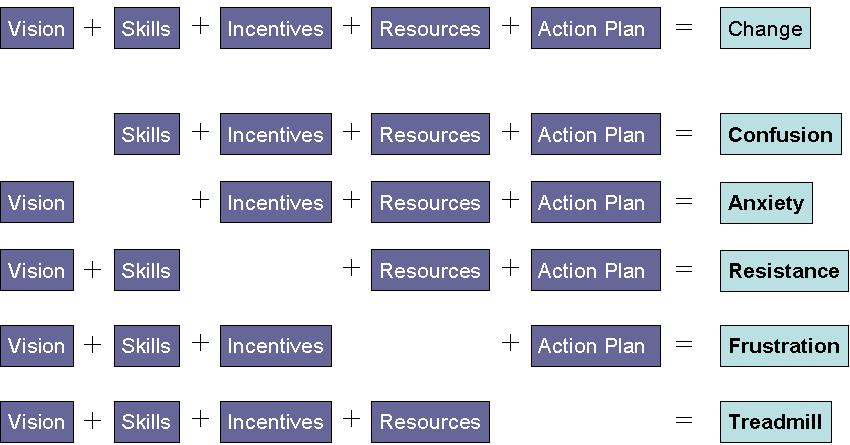
This week I am participating in an online VLE conference and I came across this graphic on a slide in a presentation by Philip Butler (Senior e-Learning Adviser for JISC's London RSC) - apparently it originates in the States with someone called Andrew Williams (new name to me). So hat tips in all the right directions.


At first I thought it was just a bit of glib rah-rah stuff, but as Philip unpacked it in his presentation I realised how much good, solid sense it made. It had obviously been well thought out. This is the sort of thing that needs to be converted into a poster for some people's office walls, and taped to a few mirrors.

If your organisation is going through change at the moment: adopting a new LMS; going Web 2.0; getting to grips with teaching-with-technology, and struggling a bit, I recommend that you have a look at the diagram and identify the missing piece(s).

Sunday, October 15, 2006

Ardent student

I realise I haven't been posting much here in the past week, but I haven't been idle. My thoughts have predictably been focused on issues around my learning materials for my Master's degree course. Rather than bore you silly with stuff related to my course, and also with a view to encouraging my classmates to get bloggin' I've created a new blog for these reflections. I opted for edublogs, since most of my classmates are teachers and edublogs seem to offer a lot that would be helpful to people in the teaching profession. The blog's name (Ardent Student) is due the fact that I acknowledge that I am an utter learning geek - what the British call an "anorak". Already, Tuesday evenings have become something I look forward to, in spite of the fact that it adds pressure to my already full schedule, and I really get tense about the fact that I have so much interesting reading to do and so little time to do it in. I find myself reading recommended texts after midnight when a more sensible person would be pushing Zs.

By contrast, I was supervising my 13 year old son's homework a few days ago. The material that he was working on was fascinating. I found it very easy to get caught up in it. But what about my son? Was he ardent? Was he enthused? Not so's you'd notice. I commented to my husband later that teachers really seemed to make an effort these days to make homework interesting, unlike in our day. Then it hit me. My mother would probably have found my homework interesting. The work is interesting to adults because it has been devised by adults.

I don't want to get tangled up in the debate about homework: Good Thing or Bad Thing. I think the principle holds for schoolwork done in or out of school hours. I'm still not prepared to accept that children are ready to determine what they need to learn, but maybe they can help us identify how they could learn it... in ways that will appeal to the child in the equation, rather than the adult. As a student, I have a voice on the course committee. Computer game designers have testers who are children. Systems developers have a user acceptance testing process. Maybe those who devise the curriculum or the scheme of work should adopt the same approach. The child's perspective must surely add value to the process.

Hmm. This one needs further thought.

Tuesday, October 10, 2006

Interactive whiteboard with a difference

Now this is cool! From MIT, a whiteboard that "gets it", that collaborates with you. I want one. Thanks, Derek for the pointer.

A WHOLE new breed of school

As if by way of reply to my almost-postscript yesterday's post, this link via Stephen Downes, today. A web 2.0 school going up in Sydney, Australia - doing away with classrooms and revamping the timetable. I covered this on my Ardent Student blog, if you're interested in my views, so I won't go into any further depth here.

Monday, October 09, 2006

The flat world? Hardly!

I have just posted this on my family blog about a school trip planned for my elder son:

Björn and I have just been to a meeting at school for those who want to take part in a Tanzanian exchange in August 2008. They will climb Mt Kilimanjaro, spend two weeks in a Tanzanian boarding school, go on safari and finish off with two days on the beach on Zanzibar. It sounds like the growth experience of a lifetime. He is dead keen, so he didn't hear the words like: altitude sickness, malaria, diarrhoea, long-drop toilets, lecture style lessons, no textbooks.

In the two years leading up to that time, they will have to raise £100K to pay for their trip out and the Tanzanians' trip here (there is no way they can pay for themselves). This will involve both group and individual fundraising efforts. They will attend basic Swahili lessons, although their lessons will be in English, and undergo training in hill/mountain walking. While they are there, they will carry out community work in an orphanage.

The teachers who will lead the party went over in the summer and found the conditions in the orphanage quite hard to handle - especially in respect of the way those with special needs - especially mental disabilities - are treated. They also had to watch the slaughter of a goat, which they found tough, since they expected the goat to die quickly, which it didn't.

I think the girls who go will find it even more difficult, since the girls' school is inferior to the boys' and their conditions harsher. Before they go home for the holidays, the Tanzanian girls' heads are shaven so that their parents aren't tempted to take the opportunity to marry them off instead of educating them.

Many of the "boys" at the boys' school are in their 20's, which John and I would have taken for granted, being familiar with African education, but it shocked the English, since the school system here is based on age, rather than progress. Neither of the schools has any ICT kit whatsoever, and the few textbooks they have date back to the 60's or earlier. Not all the children even have their own pens.

I'm sure it will be the experience of a lifetime, if he is able to produce the level of commitment necessary to raise the funds and acquire the skills required. It's bound to broaden him and open his eyes to his own privileged state. We will support his efforts in every way we can, but he needs to take ownership of this himself - this is is his trip, his project.

When I have questioned the notion of the flat world, it is these sorts of conditions that inform my position. I grew up in the third world, although I enjoyed a priveleged lifestyle, and there are vast swathes of communities that aspire to the level of "sophistication" described above. I have seen some of them with my own eyes.

Since I know someone is likely to bring it up, let me beat you to the punch... isn't it sad that, although our schools look like something from a different planet, the education system has adapted so little as to be recognisably the same process as takes place in the archaic environs of Tanzania?

Friday, October 06, 2006

How has Web 2.0 changed your teaching/learning experience?

This is an appeal for testimonials. My next module for my Master's degree is ICT in Teaching and Learning. Please would you consider popping over to the edublog I have created for reflection on my studies to contribute your story? Since my regular readership is too small to build up a portfolio of any great size, I would also greatly appreciate any of your own readers pointed in my direction to share their stories. Of course, many of you (particularly Vicki) already address this subject regularly on your blogs, and I will cull much material from legacy posts, but I would also like to hear the stories of people at different stages of the process of exploring new means to deliver or acquire learning.

Wednesday, October 04, 2006

How the heck did I get spammed?

I've only ever heard bad things about Walmart in respect of the way they treat their people, but today they infringed on my space: they spammed my blog with an advert for Hallowe'en stuff.

Now this annoys me on several levels: first of all, I do not observe Hallowe'en - in my view it is a dreadful festival (no offence to all you Americans out there). Secondly, I live in the UK and would not order my celebratory accoutrement from a supplier that would have to use international postage to get them to me. Thirdly, and most crucially, I have word verification enabled on my blog. So how did they get past that?

I have now enabled comment moderation as well, something I could have lived without, but would really appreciate any views as to whether this represents the start of a new wave of spambots that can crack word verification.

Postscript: and the "comment" didn't show up on my CoComments, either - go figure!

Tuesday, October 03, 2006

Gamekeeper turned poacher

This article from CNET appeared in my news aggregator this morning. It's a worrying thing that people who are actively involved in investigating crimes against children sometimes seem to get drawn in themselves. I wish I could remember where it was that I recently read of someone found to have an incredible number of child porn images on his computer (I mean thousands upon thousands) - having been himself responsible for tracking down and bringing such voyeurs to justice. The morbid fascination aspect appears to overcome the inherent revulsion over time, perhaps they become desensitised by constant exposure.

I know that I caught myself watching a news story about some horrific event recently while eating my dinner... and I can't even remember what the event was. Just a few years ago, coverage of the genocide in Rwanda put me off my food altogether and had me simultaneously sobbing and retching on and off for days. Seeing the plight of those newly widowed women with starving, dying children made me take positive action within the community I was in a position to reach. I was passionate, dedicated, committed. And I made a difference - albeit a small one. But now? I write out the occasional cheque as a salve to my seared conscience and get on with my incredibly busy life.

I know the two situations are very different, but is the principle of desensitisation not a constant? I am less affected by the plight of the people I see on television, because I have seen so many of them over the years. I am not about to take up weapons and participate in the violent slaughter of innocents, but what is the Edward Burke saying? ‘The only thing necessary for the triumph [of evil] is for good men to do nothing.

In case it sounds as if I'm coming out in favour of initiatives like DOPA, let me hasten to say that this is not the case. What I am saying is that we need to teach our children to be safe, because it seems that the difference between protector and predator is in some cases, simply a matter of time. When the gamekeeper turns poacher, the prey had better be equipped to protect itself. And just in case people think that online is the only context in which this sort of thing happens, let's just remember that we constantly hear about yet another person who was abused by his/her priest or teacher in childhood.

Online safety is one of Vicki Davis's hot topics, and she has posted some brilliant suggestions to help parents and teachers here, she also pointed to some excellent clips on this subject recently. We need more of this, and it needs to be posted everywhere where the kids are! I know I have invoked parental authority and forced my kids to view every one of the clips, in spite of their protestations that, "we already know all this stuff, Mom!" (ah yes, my boys: I remember being invulnerable and immortal - it wasn't as long ago as you might think). I don't want to scare them with horror stories, but these clips get the pitch just about right, I reckon.

Blogs in learning: what they are and what they aren't

Today, Vicki Davis has linked back one of her previous posts about the use of blogs in teaching and learning. I found it useful then, but am looking at it from a different persepctive today. She links to a post by Nicole Ellison on the empirical testing of blogs in the classroom.

I have been thinking about this from the learner perspective - trying to find ways that I might use this blog as a tool in my studies. This blog, my blogroll and my CoComments are so central to my thinking, that it is impossible to think of undertaking a complete postgraduate course without incorporating them.

Today is the deadline for my first paper, and I had considered handing it in on my blog, but, for many of the reasons Vicki gives, I decided that papers work best on paper. By and large a paper is a finished piece of work, which can be assessed. A line can be drawn under it and the teacher can comment on the content, the layout, the development of arguments, etc. A blogpost is more of a conversation. I can set out my thoughts on a subject and the whole blogosphere can tear the post to shreds, or agree, or add their own contributions. It is a work in progress, organic, and not restricted to contributions from the blog owner.

I think I might be able to use my blog as a research tool, but I can't see it becoming my delivery medium. However, this being a blog and all, I would be happy to consider suggestions as to how I might be able to incorporate this tool into my studies. All you teachers out there - what advice to give your learners? Would it work for me?

Monday, October 02, 2006

Reflective professional development

I have just submitted my first assignment for the MA course. I suspect there is unlikely to be another assignment as easy as this one, since no research was required! The idea was to write a 1000 opening summary for a reflective professional development assignment that looked at my journey to the MA course in terms of:

  • previous study
  • in-service training in school/college
  • professional role
  • other experience/interests
  • present focus
The summary was to show evidence of planning, analysis and reflection, as well as an explanation as to how the MA course fits in with career plans, etc.

Since my route to the course has been somewhat haphazard, it was tricky to cover the journey within the 1000 word limit (that's my story, anyway!). Later we will provide updates. I presume the idea will be to indicate how the MA is measuring up to initial expectations and if/how what we learn is impacting our lives, both professional and personal. Since my interest in the course was mainly due to a module called the Nature of Knowledge that has since been discontinued, this is a bit of a sore point at the moment! What also niggled me somewhat was the fact that, in spite of assurances that the course was not purely aimed at people in the formal education sector, the wording of the point about in-service training (see my second bullet point above) would indicate otherwise. However, it isn't all doom and gloom, I will take from the course what I can get, hoping to put some structure around what I already know as well as to fill in the gaps and learn more along the way. In my class of about 23 people, most of us middle aged, the wealth of experience represented has got to be worth sticking around for!

By way of coincidence, David Warlick's potted history of his teaching career made me smile today. It's an upbeat anecdote and gives me context for someone I respect. Perhaps he's been given a similar assignment! I'll spare you the full text of mine: 1000 words makes for a lot of text, but I couldn't help contrasting his post with a section from my assigment that read:
A student counsellor conducted a battery of tests and advised me that I showed an inordinately high aptitude for teaching, but almost no aptitude for working with children. Sadly, it seems it was not as evident to him then as it is to me now that, ergo, I should teach adults. I was not even aware that adults undertook any learning. With more knowledgeable guidance, my career path might have been more direct than it has proved.
As it happened, I taught drama part-time at a private school of performing arts during my final year at college in order to meet overheads, and turned out to be far from inept at it. At the time of the tests, though, I was adamant that I didn't want to have anything to do with children. With hindsight I realise that having a modicum of intelligence enabled me to manipulate the results to reflect exactly that. Just goes to show...

In spite of the student counsellor's lack of insight/foresight, I wound up in the world of adult learning at the age of 24 anyway. So I had taken 8 year detour, and picked up a lot interesting skills and experiences along the way. And without the necessary piece of paper in the form of a B degree to back me up, I was forced to do things hard way once I got started: building relationships with people, networking, word-of-mouth, busting a gut to ensure that the quality of my materials were beyond question... and my presentations memorable, providing follow-up evaluations at no extra cost. That too, served me well, I reckon. So no harm, no foul.

When all's said and done I think it turned out okay. Except when people ask me (or my husband, or my kids) what I do for a living. The short answer gives rise to looks of puzzlement, and the longer explanation causes eyes to glaze over! Ah well.

Friday, September 29, 2006

Homework and e-tutoring

Today, this Reuters article about outsourced private tutoring and homework popped in to my news aggregator. It put me in mind of recent posts by Harold Jarche among others.

Since I work outside of the field of formal education, I don't really feel qualified to pass judgement on whether this is a Good Thing or a Bad Thing, but it would be interesting to watch the conversation develop. I feel a bit like Diane Stark Rentner of the Center on Education Policy in Washington, who says, in the article:

"The big test is whether the kids are actually learning. Until you answer that, I don't know if you can pass judgment on whether this is a good or bad way to go,"
A Blogger search for "homework" revealed several blogs that are covering this topic at the moment, including this response to the original Reuters article from Michael Shedlock.

Obviously, there is some resistance to off-shore e-tutoring from teachers' unions in the US, who feel that the quality of tutoring that the kids receive online will not measure up the standards of an onshore provider. If it is true, as Michael quotes Time CNN as saying, that "80% of the kids entitled to after-school tutoring--at taxpayers' expense--aren't getting it", then surely it's better than the status quo. Do I get the impression that these folks would rather that the kids continued to underperform until such time as they can find a solution that they control?

From where I sit it all seems a bit hinky, but then I'm an outsider.

Tuesday, September 26, 2006

Watch out for those assumptions

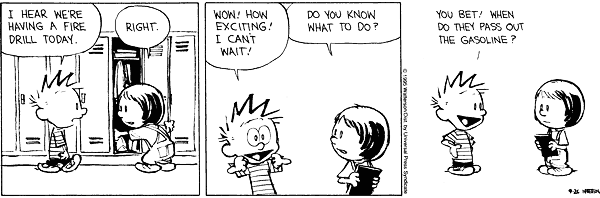
As regular readers will know, I have a weakness for Calvin & Hobbes, and a penchant for seeing learning and teaching parallels in them. Today is another of those:
I love the fact that Calvin has completely misinterpreted the purpose of a fire drill. I suspect most of us would have loved a drill that allowed us to practise burning down our schools. The thing is though, that it's called a fire drill. If you know that drill means practice, and you're 6 years old with a tendency to lateral thought, what the heck else are you going to think?

This cartoon opened the door to a forgotten tupperware cupboard in my mind and, as is the way of tupperware cupboards, the contents all came tumbling out. Memories of incidents where assumptions were made about the way things were being interpreted. In case you fancy a chuckle, I'll list some of them at the end of the post.

As learning professionals, we need to be particularly aware of this pitfall. If you're a teacher in the classroom, and you're able to identify that something got lost in the translation, at least you can put it right. But what if you're designing an elearning resource, to be used by some distant person in some remote location? There is no opportunity then to fix it - no way of even knowing that the wrong conclusion has been reached. This is why user testing is so important. You might know what you mean, but how do you know everyone else does?

And so to the tumbled tupperware:

  • When I was three and my mother was expecting my younger sister, my father explained that he had lovingly planted a seed in my mother's tummy that was growing into a baby. Later that day, I had to be given a purge to rid my young stomach of the enormous number of canna lily seeds I had been swallowing for all I was worth so that I could grow a baby of my own
  • Debbie was buying shampoo in the local supermarket. Her little brother was at the stage where he felt the need to read all the labels, just to prove he could. "For greasy hair," he read, "Why do you want greasy hair, Debbie?"
  • Years ago I was describing my first ever experience as a wedding guest to my 11 year old sister, and shared the gossip that one of my peers had got drunk during the toasting because she downed a whole glass of bubbly each time instead of taking just a sip. Robyn asked how you could possibly drink champagne while dancing, "Doesn't it spill?" I was nonplussed. "Isn't the toe sting like a tap dance?" she asked.
  • Bridget's class of 7 year olds was completing a worksheet. The grain of the wooden desks was causing havoc with their penmanship, so she suggested they lean on a book. Most of the children dutifully popped a book under the worksheet to good effect. One little lad sat bolt upright in his chair and continued to struggle. "Matthew, why don't you lean on a book, as I suggested?" she asked. "I am Mrs Bridget," he replied, proving his point by pulling out the book he had clamped between his rigid back and the chair.
  • I was walking and laughing with my son recently and jokingly responded to one of his remarks, "Ooh, you're playing with your sick leave, there". "What's a sick leaf?" he asked. Through my laughter I explained the concept of time off for ill health as opposed to holiday. He gave me a "puzzled" look and insisted "Yeah, whatever, but what's a sick leaf?"
I could keep going, but I'm sure you have even funnier/more telling examples of your own. Feel free to share!

Wednesday, September 20, 2006

Early reflections of a post-grad student

Last night I attended the first session of my Master's degree in educational studies at Oxford Brookes University. There were 22 of us present and, predictably, most of my fears going in were unfounded (I garnered a whole new set to fill the vacuum that they left, though!).

I was not the oldest person there, not by a long shot. In fact, I was pretty much the average I would estimate. I was not the biggest mouth there, either. That role went to someone else... no contest. I was very relieved, since it is often my designated role to be the speaker-upper. I was not the person with the greatest sense of inadequacy. I was not the only foreigner (I don't think - in a cosmopolitan place like the UK, it's not always obvious). I was not the one with the longest gap since my last bout of formal learning. The course leader did not opt for a lecture style and made it clear that she would not be doing so at any point. The rest of the group seemed really pleasant and mutually supportive. The campus was not forbidding and intimidating.

The course leader had arranged for a past student to come in and talk to us. His dissertation is due for submission in a few weeks, so he is at the opposite end of the process. He came to talk to us about things he wished he had known at the outset and to answer our questions. He talked about allocating time and space to the learning programme, about making use of peer support and about knuckling down to writing instead of faffing about and telling yourself you've done a lot. This was very useful. However, while it came at a point when all the above fears had been allayed, it gave rise to that whole new batch I mentioned:

  • This chap works in a school. After 3pm, his time is how own, and he can mould his marking and prep around other commitments.
  • He gets the school holidays.
  • His (private) school gave him a day off each week to work on his course assignments.
  • He has no children.
  • He found it tough to get the work done.
Urk. My working day ends at 5pm. I have 20 days leave per year. I get no time off work to complete assignments. I have two children. AM I NUTS????

Commenters on my earlier post may be interested to hear that there was no debate about the Hargreaves lecture. The assignment that came out of this was related to critical reading. I shall have to revisit the conversation about "the crit". Also, to my utter relief, the course leader was not about to adopt a psychophantic attitude towards the lecture, and referred to Hargreaves as a "so-called expert". When the designated speaker-upper pointed out that the phrase "so-called" implied a measure of criticism, her response was a level, "Absolutely". One more fear allayed.

And so to work, and work, and work.

Tuesday, September 19, 2006

Learning through technology-enhanced collaboration

Interesting feature with this title in IST Results today. I find resonance with this assertion from Chris Kew, TENCompetence’s dissemination officer at the University of Bolton in the UK:

Most current e-learning platforms, he says, fail to “actively engage the learner in anything beyond electronic page-turning and the passive consumption of knowledge."
Too right! And those of us poor schmoes (sp?) trying to do something about it are having a hard time selling the idea to (s)he-who-signs-the-cheque.

Life is not a computer game: discuss

If this title sounds like an exam question, it with good reason. It's the nature of the question posed by Vicki Davis for her students in the wake of the events at Dawson College. Vicki has been tackling this and related issues in her usual call-it-like-it-is-and-suggest-solutions manner lately.

Nor is this an isolated incident. In the 18 September issue of Time magazine, this story appears. A kid with promise, a kid with a future, a kid with his whole life ahead of him, now likely to spend the next several years of it behind bars for armed robbery and attempted rape - the line between the real world and his online life having blurred.

A recent episode of CSI Miami explored this as its story line (note: recent in the UK - possibly long past in the USA) - a bunch of universtiy students decided to take an online game one step further and move it into the real world. I know that CSI is just a story, but at least it will have brought this issue onto the radar of John and Jane Citizen.

I know the argument rages back and forth about whether violence on screen impacts people's behaviour and there are many who insist that this is not the case. However, if what we are exposed to doesn't impact how we behave, why are advertising budgets so large?

Simulation games employ an alternative morality - it's important that our children understand that that morality does not transfer into the real world, even if (as in Second Life) the virtual money does. As parents, I think we need to make an increased effort to teach our children healthy online habits, while also engaging them off-line, and teaching them how to engage with people "with skin on".

Monday, September 18, 2006

Education research: not off to a good start!

Tomorrow I will attend my first lecture on my MA course. Subject: Reflective Professional Development and Educational Research. By way of preparation I have been sent a 12 page printout of a lecture which I must read before attending the session. The title of the lecture is "Teaching as a Research-Based Profession: Possibilities and Prospects". It was delivered to the Teacher Training Agency in 1996 (that's 10 years ago!) by David H Hargreaves, who was then Professor of Education at the University of Cambridge (perhaps he still is - it has proved unexpectedly difficult to establish whether this is the case). Googling the title of the lecture, I gather it had enormous impact, although I had not before read it in its entirety.

Prof Hargreaves compares education to medicine as a research profession. He says:

The medical profession has gained in public prestige concurrently with the growth of its research. The teaching profession has not.
He contends that, unlike research into the natural sciences, educational research is non-cumulative. He refers to the lack of a knowledge base for teachers, and highlights the difference in the way the two professions approach applied research, particularly in the light of the fact that so little of the research is undertaken by teachers themselves. Doctors have access to journals to keep them abreast with developments and advancements in medical research. Teachers do not, nor do they bemoan the lack of them, according to Hargreaves. He talks about the way in which research has driven medicine forward and regrets the fact that the same cannot be said of education.

I'm still assimilating the material, but thus far (and in no particular order) I have had the following thoughts on his comparison between the fields of medicine and education:
  1. I would like to suggest that education is to learning what paediatrics is to medicine. It is that part of the field that is practised involving children. Paediatricians try to ensure that sound medical practice is followed as they tend their patients. Teachers try to ensure that effective learning takes place as they tend to their students. While, as Hargreaves says, there may not be a huge body of research on advances in education, but there are huge quantities of information on the subject of learning. It is the persistence in the view that education is somehow separate from learning (or that learning is a subset of education) that means that the results of learning and behavioural research do not make the transfer. Education is something that is done to people, while learning is something that people do. The goal is for learning to take place during the process of education, but this is sadly not always the case, as we often hear.
  2. Medical research is very often carried out on other creatures in laboratory conditions first. Since mammalian anatomies have so much in common, it is possible to extrapolate from the findings of such research. However, it is difficult to imagine a situation in which specifically educational research can be carried out on animals! On the other hand results of learning and/or behavioural experiments carried out on animals are well known (think Pavlov, Skinner et al). Mind you it could be argued that the transfer of these findings to humans is questionable, since behaviour patterns show less commonality across species. It is true that some educational research is carried out on "human subjects" although it is probably not politically correct to refer to these changes in policy as "experiments". (My own sister's ability to spell is probably entirely due to genetics and my mother's intervention, since she was one of the live subjects of a short-lived and failed experiment in literacy teaching called i/t/a - initial teaching alphabet. What an unmitigated disaster that was! And the cause of a whole batch of permanently poor spellers)
  3. Many medical advances have been made under the most adverse of conditions. For example, plastic surgery advanced in leaps and bounds during world war 1. Education is thankfully not often presented with such "conducive" conditions.
  4. Doctors do not have a curriculum to follow. And to me, this is a key point. They see their patients one at a time, and treat each one according to their needs. This frees them up to apply new thinking (their own or the outcome of recent research). The face of medicine has changed enormously as a consequence. Teachers do not have that measure of freedom. They see their learners in batches, and must follow the curriculum in order to prepare their charges for the final exam. As a consequence, the face of teaching has changed far less over the centuries.
  5. People visit the doctor because they recognise they have need of medical attention. People go to school because the law says they must, or because their parents have told them of the value of a good education.
  6. Medical researchers tend to explore existing conditions. Education faces the challenge of preparing people to do jobs that do not yet exist on equipment that has yet to be invented, solving problems that have yet to be identified.
Having said all of that, out there in the blogosphere, which didn't exist when Hargreaves delivered this lecture, teachers are faithfully recording the results of their efforts: successes, failures, lessons learnt - homing in on the education arm of learning. The Vicki Davises, the Jeff Utechts, the Graham Wegners, the Bob Sprankles of the world. And, at the post-compulsory end, the likes of George Siemens and Barbara Ganley. Blogs, podcasts and wikis abound. And, while they may not constitute formal research, they do constitute a body of knowledge which can be accessed by any with the interest and the means.

Now it just remains to be seen whether I am able to hold my tongue and be civil when we come to discuss this subject tomorrow evening, or whether I leap aboard my soapbox, throw caution to the wind and stick my foot very firmly in my mouth. I am hoping for the former, but that soapbox is pretty close to being my natural habitat!

Friday, September 15, 2006

More on the changing face of literacy

Now that I've started to put some structure in place around my thinking on how what constitutes literacy has changed over time, I find that my mind is worrying at it like a sore tooth. I mentioned yesterday, that the written word had gone from being something that was elitist to something that was widely accessible. And of course, somewhere in the middle of the night, my subconscious mind found dusty recollections on some of Mark Weiser's work that I mulled over some time back.

He also referred to the process of the written word becoming ubiquitous. There was once a time when the written word could only be accessed by a select few and then the individual had to go to where the written word could be found. Over time, the written word became ubiquitous - a part of our world, accessible from where we happened to be, even to the point where it appears as grafitti. We are so rich in words, that we can afford to treat them as waste.

His own goal was to see us reach the same state in respect of computing - hence the term ubiquitous computing. Rather than the user having to go to where the computer was to make use of its functions and features, he looked to a world where the computer entered our world. We're getting there. I remember the days when computers were kept in rooms so cold all the computer (not called IT, yet) staff wore jumpers to work, even in the middle of summer. Now we see a far more portable technology and always-on connectivity, thanks to wifi.

Thinking in terms of modern literacy, imagine how lost you would be if you were trying to navigate your way around a foreign country where all the street signs were only in the native language, which you didn't speak. When we travel to Sweden, I am always glad of the fact that we make use of a combination of public transport and the good grace of family members. Driving on the right hand side of the road would be tough enough to cope with, but even as a passenger with none of the responsibilities associated with safe driving, I am still unable to read the signs before we've passed them. I'd be fine if I could stop in front of each sign for a minute and figure it out, but this is not exactly practical. In Sweden, I am not sufficiently literate to be independent and this makes me entirely reliant on my husband and his extended family (and on the fact that almost all Swedes speak beautiful English). This is how it must be for people who can't read their own language. Just thinking about the doors that are only open if you can read, I find I can't imagine how disabling it must be not to be able to do so.

And now we face the fact that the inability to make use of ICT technology is closing door after door as well. In my lifetime, will this form of illiteracy become as disabling as the inability to read? It looks increasingly like it.

On the back of Mark Weiser's work, much attention is being paid to the notion of ubiquitous learning (sadly no entry in Wikipedia yet, but you can Google it) - learning that goes to where the people are, rather than learning that must be accessed in a special environment (do we see a pattern emerging?). It is a subject on its own, and I have touched on it briefly before (here and here), but I think it has pertinence to this topic in that it is likely that it will presuppose functional and IT literacy to an increasing degree.

And, as a sad postscript, I was just reading this week about the number of kids coming through the education system with no more than the most basic reading and writing skills. We've let them down, folks. Imagine trying to earn a living when faced with all those closed doors - it doesn't leave a whole lot of legal options!