I have shared before about my passion for cryptic crossword puzzles, codewords and other word games. But there are other games, too. And these I'm not so great at.
I enjoy Hexic, which presents you with a honeycomb of multicoloured hexagons, which you must manipulate to form clusters of three or more which then disappear from the screen. There's more to it than that with starflowers and black pearls to be earned. My spatial skills are not great, so I have never achieved a black pearl. I also like to play Rotate Mania, which presents you with a grid of squares split into coloured sections (two, three or four colours). You must once again manipulate these to group together four or more quarters of the same colour and eliminate them from the board. The aim is to clear the board. I have never achieved that. Not once! A significant plus to this game (for me) is that it isn't timed! I hate it when a game starts counting down. I panic and don't achieve anything further.
But the game I am worst at is the one that is apparently responsible for th e fact that the most common demographic for online gamers is middle-aged women: Bejeweled (heck, I even struggle with the fact that it only has one L!). Sheesh, was there ever anyone so sucky at a game? In this version, you get one minute. One. And the last 15-20 seconds or so involve a countdown. So I get 45 seconds (unless I remember to mute the sound). In this game, you have to switch 'jewels' around to create rows or columns of three or more, which explode and disappear from the board. I just can't see them. Sometimes, even when I click hint and the little arrow points at a jewel I should move, it still takes me valuable seconds to figure out what to do with it.
 I wonder if this blind spot has any bearing on the fact that I also sucked at geometry at school, and am hopeless at chess. I knew the geometry theorems and could do the 'proofs' for those. But I couldn't look at a complex diagram and apply the kind of reasoning necessary to know that all the factors working together mean that angle C=97˚. Similarly, I know how each chess piece moves. I know the principles. I know about things like pinning and castling and that kind of stuff. But I can't devise a strategy in which all the pieces work together to capture the opponent's king while protecting my own. I can't think three moves ahead and play purely reactively, getting my *ss handed to me every time.
I'm much the same when it comes to pool. I can't plan what I'm going to do next and play the cue ball so that it winds up in the right spot for the next shot. I can only play one ball at a time and have to re-assess the table each time I pot one.
I've never been able to figure out which kind of -uctive (ad-, ab-, de- and in-) reasoning is which. All the explanations sound the same to me. As well as involving spatial awareness, do these situations all involve one of those -uctions? And, if so, which one?
Even some of the word games seem to fall into this hole. For example. I am hopeless at Scramble!
Tuesday, May 12, 2009
Different types of reasoning

Tuesday, October 21, 2008
Why I like cryptic crossword puzzles
I'm not very good at identifying the different types of '-uctive' reasoning (adductive, deductive, reductive...), but I do like to exercise them. There is a UK newspaper I buy purely for the puzzles. I have no time for its sensationalist right wing politics, but it has a 4 page spread of the best puzzles. I buy the paper, take out the middle pages and recycle the rest. Because this is a monumental waste and distinctly un-green, I restrict myself to buying the paper only when I have a longish train journey to make.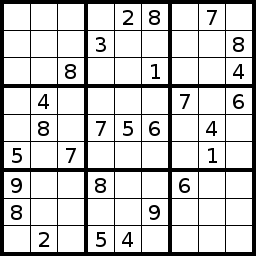

But my greatest love, by far, is crosswords. Usually, when I say this people picture this kind of thing.
What I like is a kind of crossword that seems peculiar to England and a few of its ex-colonies. The cryptic crossword puzzle. My husband, the techie, fails to see the point, which is kind of sad, because I had fond notions of the two of us solving the morning crossword over toast and tea in our twilight years. Sigh. Bliss. To my mind, it involves the same sort of reasoning involved in programming. But I've never been a programmer, so perhaps I'm wrong about that.
Every day, my husband dutifully brings home a freebie paper distributed during the homeward journey. He does the sudokus on the train... which I tolerate ;o) and I do the crossword in bed before I turn off the light.
I'm not altogether sure what sort of reasoning is involved, but the answer is always in the clue somehow. For example, in the clue "Spoil in a remarkable way (3)" the answer is concealed. In the clue "Healthy spasm (3)" we're dealing with a bit of wordplay to come up with the answer: fit. Another example of which is to be found in my favourite clue from Monday's paper this week: "Dejected - no liquor left! (3,2,7)" to which the answer, in case you're interested, is out of spirits. Sometimes the answer is hidden, sometimes it's an anagram, sometimes it involves a bit of lateral thinking.
The daily cryptic crossword was a feature of my childhood. My mother is a crossword junkie, so she was regularly to be seen poring over the puzzle.
When the extended family gathered at my grandparents' home for the Christmas holidays, with all 14 of us under one roof (bear in mind that it was the height of summer, so this might involve some people camping out on the front lawn, or in the garage), the daily crossword was completed as a team exercise. I had no contribution to make...yet... but I loved the conversation that ensued. I loved the collaborative problem-solving. The brainstorming that generated some ridiculous suggestions (some of which turned out to be correct!). The cameraderie, the pursuit of a common goal. The good humoured bickering when one person got the the puzzle first and solved it before anyone else had got a look in.
These are drivers I have brought with me to the field of learning. Call me an idealist if you like, but I have seen it in action. I have seen people engaged in team problem solving... and it worked so well, even when the last clue remained stubbornly unsolved, that it remains one of my fondest memories to this day.
So to end... a few cryptic clues for you to solve. I will publish the results in a comment on this post, so you can choose to see them or not. After that, I will curl up in a sunny corner (yes, the sun is shining) with a cup of tea and today's puzzle.
Oh... and if anyone can tell me what kind of '-uctive' is involved, I'd be thrilled to learn... as long as it isn't unproductive!
- Negligent about a girl (6)
- A church provides and unbeatable service (3)
- Finish sketch for a particular purpose (4,2,2,3)
- Perhaps gravity caused him to add fresh weight to science? (6)
- The practice of the American era (5)