Friday, September 29, 2006

Homework and e-tutoring

Today, this Reuters article about outsourced private tutoring and homework popped in to my news aggregator. It put me in mind of recent posts by Harold Jarche among others.

Since I work outside of the field of formal education, I don't really feel qualified to pass judgement on whether this is a Good Thing or a Bad Thing, but it would be interesting to watch the conversation develop. I feel a bit like Diane Stark Rentner of the Center on Education Policy in Washington, who says, in the article:

"The big test is whether the kids are actually learning. Until you answer that, I don't know if you can pass judgment on whether this is a good or bad way to go,"
A Blogger search for "homework" revealed several blogs that are covering this topic at the moment, including this response to the original Reuters article from Michael Shedlock.

Obviously, there is some resistance to off-shore e-tutoring from teachers' unions in the US, who feel that the quality of tutoring that the kids receive online will not measure up the standards of an onshore provider. If it is true, as Michael quotes Time CNN as saying, that "80% of the kids entitled to after-school tutoring--at taxpayers' expense--aren't getting it", then surely it's better than the status quo. Do I get the impression that these folks would rather that the kids continued to underperform until such time as they can find a solution that they control?

From where I sit it all seems a bit hinky, but then I'm an outsider.

Tuesday, September 26, 2006

Watch out for those assumptions

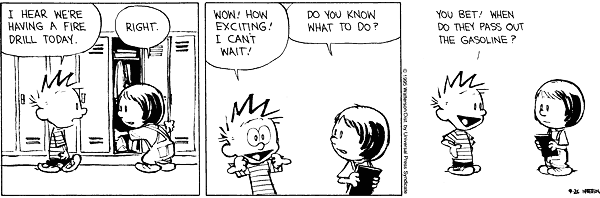
As regular readers will know, I have a weakness for Calvin & Hobbes, and a penchant for seeing learning and teaching parallels in them. Today is another of those:
I love the fact that Calvin has completely misinterpreted the purpose of a fire drill. I suspect most of us would have loved a drill that allowed us to practise burning down our schools. The thing is though, that it's called a fire drill. If you know that drill means practice, and you're 6 years old with a tendency to lateral thought, what the heck else are you going to think?

This cartoon opened the door to a forgotten tupperware cupboard in my mind and, as is the way of tupperware cupboards, the contents all came tumbling out. Memories of incidents where assumptions were made about the way things were being interpreted. In case you fancy a chuckle, I'll list some of them at the end of the post.

As learning professionals, we need to be particularly aware of this pitfall. If you're a teacher in the classroom, and you're able to identify that something got lost in the translation, at least you can put it right. But what if you're designing an elearning resource, to be used by some distant person in some remote location? There is no opportunity then to fix it - no way of even knowing that the wrong conclusion has been reached. This is why user testing is so important. You might know what you mean, but how do you know everyone else does?

And so to the tumbled tupperware:

  • When I was three and my mother was expecting my younger sister, my father explained that he had lovingly planted a seed in my mother's tummy that was growing into a baby. Later that day, I had to be given a purge to rid my young stomach of the enormous number of canna lily seeds I had been swallowing for all I was worth so that I could grow a baby of my own
  • Debbie was buying shampoo in the local supermarket. Her little brother was at the stage where he felt the need to read all the labels, just to prove he could. "For greasy hair," he read, "Why do you want greasy hair, Debbie?"
  • Years ago I was describing my first ever experience as a wedding guest to my 11 year old sister, and shared the gossip that one of my peers had got drunk during the toasting because she downed a whole glass of bubbly each time instead of taking just a sip. Robyn asked how you could possibly drink champagne while dancing, "Doesn't it spill?" I was nonplussed. "Isn't the toe sting like a tap dance?" she asked.
  • Bridget's class of 7 year olds was completing a worksheet. The grain of the wooden desks was causing havoc with their penmanship, so she suggested they lean on a book. Most of the children dutifully popped a book under the worksheet to good effect. One little lad sat bolt upright in his chair and continued to struggle. "Matthew, why don't you lean on a book, as I suggested?" she asked. "I am Mrs Bridget," he replied, proving his point by pulling out the book he had clamped between his rigid back and the chair.
  • I was walking and laughing with my son recently and jokingly responded to one of his remarks, "Ooh, you're playing with your sick leave, there". "What's a sick leaf?" he asked. Through my laughter I explained the concept of time off for ill health as opposed to holiday. He gave me a "puzzled" look and insisted "Yeah, whatever, but what's a sick leaf?"
I could keep going, but I'm sure you have even funnier/more telling examples of your own. Feel free to share!

Wednesday, September 20, 2006

Early reflections of a post-grad student

Last night I attended the first session of my Master's degree in educational studies at Oxford Brookes University. There were 22 of us present and, predictably, most of my fears going in were unfounded (I garnered a whole new set to fill the vacuum that they left, though!).

I was not the oldest person there, not by a long shot. In fact, I was pretty much the average I would estimate. I was not the biggest mouth there, either. That role went to someone else... no contest. I was very relieved, since it is often my designated role to be the speaker-upper. I was not the person with the greatest sense of inadequacy. I was not the only foreigner (I don't think - in a cosmopolitan place like the UK, it's not always obvious). I was not the one with the longest gap since my last bout of formal learning. The course leader did not opt for a lecture style and made it clear that she would not be doing so at any point. The rest of the group seemed really pleasant and mutually supportive. The campus was not forbidding and intimidating.

The course leader had arranged for a past student to come in and talk to us. His dissertation is due for submission in a few weeks, so he is at the opposite end of the process. He came to talk to us about things he wished he had known at the outset and to answer our questions. He talked about allocating time and space to the learning programme, about making use of peer support and about knuckling down to writing instead of faffing about and telling yourself you've done a lot. This was very useful. However, while it came at a point when all the above fears had been allayed, it gave rise to that whole new batch I mentioned:

  • This chap works in a school. After 3pm, his time is how own, and he can mould his marking and prep around other commitments.
  • He gets the school holidays.
  • His (private) school gave him a day off each week to work on his course assignments.
  • He has no children.
  • He found it tough to get the work done.
Urk. My working day ends at 5pm. I have 20 days leave per year. I get no time off work to complete assignments. I have two children. AM I NUTS????

Commenters on my earlier post may be interested to hear that there was no debate about the Hargreaves lecture. The assignment that came out of this was related to critical reading. I shall have to revisit the conversation about "the crit". Also, to my utter relief, the course leader was not about to adopt a psychophantic attitude towards the lecture, and referred to Hargreaves as a "so-called expert". When the designated speaker-upper pointed out that the phrase "so-called" implied a measure of criticism, her response was a level, "Absolutely". One more fear allayed.

And so to work, and work, and work.

Tuesday, September 19, 2006

Learning through technology-enhanced collaboration

Interesting feature with this title in IST Results today. I find resonance with this assertion from Chris Kew, TENCompetence’s dissemination officer at the University of Bolton in the UK:

Most current e-learning platforms, he says, fail to “actively engage the learner in anything beyond electronic page-turning and the passive consumption of knowledge."
Too right! And those of us poor schmoes (sp?) trying to do something about it are having a hard time selling the idea to (s)he-who-signs-the-cheque.

Life is not a computer game: discuss

If this title sounds like an exam question, it with good reason. It's the nature of the question posed by Vicki Davis for her students in the wake of the events at Dawson College. Vicki has been tackling this and related issues in her usual call-it-like-it-is-and-suggest-solutions manner lately.

Nor is this an isolated incident. In the 18 September issue of Time magazine, this story appears. A kid with promise, a kid with a future, a kid with his whole life ahead of him, now likely to spend the next several years of it behind bars for armed robbery and attempted rape - the line between the real world and his online life having blurred.

A recent episode of CSI Miami explored this as its story line (note: recent in the UK - possibly long past in the USA) - a bunch of universtiy students decided to take an online game one step further and move it into the real world. I know that CSI is just a story, but at least it will have brought this issue onto the radar of John and Jane Citizen.

I know the argument rages back and forth about whether violence on screen impacts people's behaviour and there are many who insist that this is not the case. However, if what we are exposed to doesn't impact how we behave, why are advertising budgets so large?

Simulation games employ an alternative morality - it's important that our children understand that that morality does not transfer into the real world, even if (as in Second Life) the virtual money does. As parents, I think we need to make an increased effort to teach our children healthy online habits, while also engaging them off-line, and teaching them how to engage with people "with skin on".

Monday, September 18, 2006

Education research: not off to a good start!

Tomorrow I will attend my first lecture on my MA course. Subject: Reflective Professional Development and Educational Research. By way of preparation I have been sent a 12 page printout of a lecture which I must read before attending the session. The title of the lecture is "Teaching as a Research-Based Profession: Possibilities and Prospects". It was delivered to the Teacher Training Agency in 1996 (that's 10 years ago!) by David H Hargreaves, who was then Professor of Education at the University of Cambridge (perhaps he still is - it has proved unexpectedly difficult to establish whether this is the case). Googling the title of the lecture, I gather it had enormous impact, although I had not before read it in its entirety.

Prof Hargreaves compares education to medicine as a research profession. He says:

The medical profession has gained in public prestige concurrently with the growth of its research. The teaching profession has not.
He contends that, unlike research into the natural sciences, educational research is non-cumulative. He refers to the lack of a knowledge base for teachers, and highlights the difference in the way the two professions approach applied research, particularly in the light of the fact that so little of the research is undertaken by teachers themselves. Doctors have access to journals to keep them abreast with developments and advancements in medical research. Teachers do not, nor do they bemoan the lack of them, according to Hargreaves. He talks about the way in which research has driven medicine forward and regrets the fact that the same cannot be said of education.

I'm still assimilating the material, but thus far (and in no particular order) I have had the following thoughts on his comparison between the fields of medicine and education:
  1. I would like to suggest that education is to learning what paediatrics is to medicine. It is that part of the field that is practised involving children. Paediatricians try to ensure that sound medical practice is followed as they tend their patients. Teachers try to ensure that effective learning takes place as they tend to their students. While, as Hargreaves says, there may not be a huge body of research on advances in education, but there are huge quantities of information on the subject of learning. It is the persistence in the view that education is somehow separate from learning (or that learning is a subset of education) that means that the results of learning and behavioural research do not make the transfer. Education is something that is done to people, while learning is something that people do. The goal is for learning to take place during the process of education, but this is sadly not always the case, as we often hear.
  2. Medical research is very often carried out on other creatures in laboratory conditions first. Since mammalian anatomies have so much in common, it is possible to extrapolate from the findings of such research. However, it is difficult to imagine a situation in which specifically educational research can be carried out on animals! On the other hand results of learning and/or behavioural experiments carried out on animals are well known (think Pavlov, Skinner et al). Mind you it could be argued that the transfer of these findings to humans is questionable, since behaviour patterns show less commonality across species. It is true that some educational research is carried out on "human subjects" although it is probably not politically correct to refer to these changes in policy as "experiments". (My own sister's ability to spell is probably entirely due to genetics and my mother's intervention, since she was one of the live subjects of a short-lived and failed experiment in literacy teaching called i/t/a - initial teaching alphabet. What an unmitigated disaster that was! And the cause of a whole batch of permanently poor spellers)
  3. Many medical advances have been made under the most adverse of conditions. For example, plastic surgery advanced in leaps and bounds during world war 1. Education is thankfully not often presented with such "conducive" conditions.
  4. Doctors do not have a curriculum to follow. And to me, this is a key point. They see their patients one at a time, and treat each one according to their needs. This frees them up to apply new thinking (their own or the outcome of recent research). The face of medicine has changed enormously as a consequence. Teachers do not have that measure of freedom. They see their learners in batches, and must follow the curriculum in order to prepare their charges for the final exam. As a consequence, the face of teaching has changed far less over the centuries.
  5. People visit the doctor because they recognise they have need of medical attention. People go to school because the law says they must, or because their parents have told them of the value of a good education.
  6. Medical researchers tend to explore existing conditions. Education faces the challenge of preparing people to do jobs that do not yet exist on equipment that has yet to be invented, solving problems that have yet to be identified.
Having said all of that, out there in the blogosphere, which didn't exist when Hargreaves delivered this lecture, teachers are faithfully recording the results of their efforts: successes, failures, lessons learnt - homing in on the education arm of learning. The Vicki Davises, the Jeff Utechts, the Graham Wegners, the Bob Sprankles of the world. And, at the post-compulsory end, the likes of George Siemens and Barbara Ganley. Blogs, podcasts and wikis abound. And, while they may not constitute formal research, they do constitute a body of knowledge which can be accessed by any with the interest and the means.

Now it just remains to be seen whether I am able to hold my tongue and be civil when we come to discuss this subject tomorrow evening, or whether I leap aboard my soapbox, throw caution to the wind and stick my foot very firmly in my mouth. I am hoping for the former, but that soapbox is pretty close to being my natural habitat!

Friday, September 15, 2006

More on the changing face of literacy

Now that I've started to put some structure in place around my thinking on how what constitutes literacy has changed over time, I find that my mind is worrying at it like a sore tooth. I mentioned yesterday, that the written word had gone from being something that was elitist to something that was widely accessible. And of course, somewhere in the middle of the night, my subconscious mind found dusty recollections on some of Mark Weiser's work that I mulled over some time back.

He also referred to the process of the written word becoming ubiquitous. There was once a time when the written word could only be accessed by a select few and then the individual had to go to where the written word could be found. Over time, the written word became ubiquitous - a part of our world, accessible from where we happened to be, even to the point where it appears as grafitti. We are so rich in words, that we can afford to treat them as waste.

His own goal was to see us reach the same state in respect of computing - hence the term ubiquitous computing. Rather than the user having to go to where the computer was to make use of its functions and features, he looked to a world where the computer entered our world. We're getting there. I remember the days when computers were kept in rooms so cold all the computer (not called IT, yet) staff wore jumpers to work, even in the middle of summer. Now we see a far more portable technology and always-on connectivity, thanks to wifi.

Thinking in terms of modern literacy, imagine how lost you would be if you were trying to navigate your way around a foreign country where all the street signs were only in the native language, which you didn't speak. When we travel to Sweden, I am always glad of the fact that we make use of a combination of public transport and the good grace of family members. Driving on the right hand side of the road would be tough enough to cope with, but even as a passenger with none of the responsibilities associated with safe driving, I am still unable to read the signs before we've passed them. I'd be fine if I could stop in front of each sign for a minute and figure it out, but this is not exactly practical. In Sweden, I am not sufficiently literate to be independent and this makes me entirely reliant on my husband and his extended family (and on the fact that almost all Swedes speak beautiful English). This is how it must be for people who can't read their own language. Just thinking about the doors that are only open if you can read, I find I can't imagine how disabling it must be not to be able to do so.

And now we face the fact that the inability to make use of ICT technology is closing door after door as well. In my lifetime, will this form of illiteracy become as disabling as the inability to read? It looks increasingly like it.

On the back of Mark Weiser's work, much attention is being paid to the notion of ubiquitous learning (sadly no entry in Wikipedia yet, but you can Google it) - learning that goes to where the people are, rather than learning that must be accessed in a special environment (do we see a pattern emerging?). It is a subject on its own, and I have touched on it briefly before (here and here), but I think it has pertinence to this topic in that it is likely that it will presuppose functional and IT literacy to an increasing degree.

And, as a sad postscript, I was just reading this week about the number of kids coming through the education system with no more than the most basic reading and writing skills. We've let them down, folks. Imagine trying to earn a living when faced with all those closed doors - it doesn't leave a whole lot of legal options!

Thursday, September 14, 2006

The changing face of literacy

I've been thinking a lot about this lately, and I reckon I might like to do a paper on this for my course.

There's been a lot of conversation in the blogosphere about how the new literacy is no longer just about being able to read and write, but about being able to make use of ICT technology to learn, to share, to participate. There is concern that the focus of literacy teaching in schools is still based on a literacy that was suitable for our parents and our grandparents, but is no longer enough for us and will certainly not be enough for our children. Our children desperately need to learn keyboarding skills, but few schools provide teaching in this vital skills and even fewer make it compulsory.

This got me thinking that this is not the first time that there has been a change in what it means to be affluent in the literacy currency of the age. If we consider that literacy is a means to communicate information, to express oneself and to keep culture and or traditions alive, the following are forms of literacy that have held sway at various times in history:

  • Expressive movement and dance
  • Rituals
  • Cave painting
  • Singing and/or chanting
  • Dramatic re-enactments
  • Story telling
In the comparitively short time that people have been able to write, even that has undergone dramatic changes. At one time, people used a stylus and a wax tablet. Not that long ago, schoolchildren wrote with chalk on small slates (in fact, in the rural areas of South Africa, this was the case even in my lifetime, and might still be the case in some parts of the world) - they did not have scores of notebooks at home to refer back to. The provision of a text book to every child is a relatively new thing and is still not practised everywhere in the world. Hence the need to commit so much to memory.

Now the notebook could safely be phased out in favour of electronic alternatives and the text book looks like being phased out because of its short shelf-life. We have moved on to communal knowledge: wikis, blogs and "I keep my knowledge in my friends".

It seems to me that when other forms of literacy were the order of the day, anyone could have a go. Obviously some people would have a greater knack for it than others, as with anything, but I don't know that anyone was restricted from practising (of course I may be wrong - social anthropology not being my thing).

But then came writing and elitism. Time was once when only a select few people knew how to read and write and such skills were considered unnecessary for the unwashed masses. These people no doubt continued to rely on older forms of literacy in their relationships and the preservation of their culture, but the lack of access to the written word placed a ceiling on their prospects and expectations. The same is surely true today. Those who lack access to the skills required for current literacy are similarly disadvantaged and in danger of marginalisation.

Hmm. There's a lot to this, and I would be glad of any contributions from out there. If I do go with this for my course, I will be sure to give credit where it is due.

Wednesday, September 13, 2006

Staying in the loop!

I came across this post by Paul Graham, looking at a technology called Loopt . Of course, I'm not sure exactly how this technology will work and I presume it will only be possible to locate phones that are actually switched on. If, however, it works for a phone that is switched off, that would be even better.

I could have used technology like this recently, when my elder son disappeared off the radar one afternoon. He was due to have met a friend to go to the cinema, but there was a crossing of wires and he and the friend waited in two different places, one with no credit on his phone, the other with his phone switched off due to a flat battery (yeah, I know, but they're teenagers - what can you do?). Unable to reach each other (but actually no more than 20 metres apart as the crow flies), each gave up waiting and went his own way. Several hours later, I learned that my son had set off from home to meet a friend, but had never arrived. No-one had seen or heard from him since. He had been off the radar for more than 7 hours. How I would love to have been able to make use of some locator technology instead of having to make increasingly worried calls to umpteen parents, his guitar teacher and very nearly the police. I had decided to give it another 10 minutes before calling them when the prodigal finally called, all wide-eyed innocence and totally unaware that he had been missing - after all he knew where he was!

I can see this technology being very useful for anxious parents of switched off (and I'm not referring to the phone) teenagers.

Now to think of a way to use it to build a learning experience...

Monday, September 11, 2006

A short tale to warm the heart

Yesterday we took my mother-in-law to Heathrow. She had been with us for the weekend on her way back from an extended visit to one of her daughters in Oregon, USA to her granny flat at her other daughter's home in Cape Town, South Africa.

She's quite the globetrotter, this white-haired lady of 80. With each of her three offspring living on a different continent, she has to be. Plus of course the fact that she is a Swedish ex-pat, requiring occasional trips back to visit relatives and touch base with her heritage. Watching her head off with her two eNORmous suitcases into Heathrow airport, supremely confident and totally at home with the business of international travel, I had to admire her.

A few times over the weekend, she had surprised me with her attitudes. She had asked my younger son (he of the long, curly locks) what he used to keep his hair in such fabulous condition. She compared stories with him about having their ears pierced. She had finally had her lobes done at the age of 70+. He recently had his ear cartilege pierced. She wondered if planned to wear a stud or a cuff. She discussed career choices with both the boys and encouraged the elder one in his consideration of forensic science, calling it a fascinating field. She chatted to him about his lovelife and his part-time job. She was unfazed by the online games that they play. Where she was not totally in touch with what goes on in the life of a teenager today, she asked.

As if that isn't enough, she told me as she left that she was going to miss reading my blog. Not this one, of course, but this one. She's quite a redoubtable lady and has long since taken to communicating via email using her children's computers. She really enjoyed the added dimension of blogging. Her daughter in America has subscribed to the RSS feed via Feedblitz and the two of them kept themselves up to date with the happenings in our lives. By contrast, her other daughter has a fear of the dangers of the web, lacking any kind of virus protection on her system. She has a dial-up connection, which she uses to dive in, send and receive new emails and scurry out again. She has opted not to sign up for the RSS feed.

So there you are. At 80, while she doesn't have a blog of her own, she has been an avid reader of mine, and would no doubt read others too, if family and friends chose to keep them. So much so, that she's going to miss it when she gets home. Score one for social media.

Go Granny!

Thursday, September 07, 2006

Tim Berners-Lee and the Emperor's Web 2.0

I haven't been doing much posting lately, for reasons I have already explained, but I have continued to be a consumer, and was sufficiently galvanised by this item about Tim Berners-Lee's take on Web 2.0. He is reported to have said that Web 2.0 is "purely a blog and wiki thing".

Tim Berners-Lee, the individual credited with inventing the web and giving so many of us jobs, has become the most prominent individual so-far to point out that the Web 2.0 emperor is naked. Berners-Lee has dismissed Web 2.0 as useless jargon nobody can explain and a set of technology that tries to achieve exactly the same thing as "Web 1.0."
At the risk of sounding like an iconoclast, I don't believe that the enormous contribution that Berners-Lee has made, means that his view is automatically definitive. I'm not necessarily rejecting what he has to say, but his baby is all growed up, and other people's perceptions may well have just as much validity as his own. I know that George Siemens shouted a loud hurrah. It will be interesting to see what other responses are evoked.

Thursday, August 31, 2006

Attitude and Health: Bloom and Maslow

Things really got on top of me recently. Too many commitments, too little time, one or two conflict situations and no support mechanism. (This, by the way, has proved easily the toughest aspect of emigration: the loss of the extended family and network of friends.) I was aware that I was taking strain, but thought it would pass as it has before. Then, on Tuesday, I was on the phone to a colleague discussing a difficult situation facing us, when I suddenly started to shake fairly violently and was unable to stop for some time. I took myself off to the doctor who (no surprise) diagnosed stress, tension, anxiety. He offered chemicals, which I declined, preferring to find an alternative route.

So why am I sharing this obviously deeply personal information on this blog?

Well, I have found that this has all impacted my learning journey. I have continued to read the same blogs I read everyday, but I know I'm just skimming and I feel less inclined to follow the links and get the whole story. I have commented far less than usual on the posts I have read and I am aware that my comments lack depth and relevance. Posts to my own blogs have been very thin on the ground. My off-line reading has become restricted to page-turning fiction and only my unswerving passion for cryptic crossword puzzles and sudokus have seen to it that my brain gets any exercise at all.

In many respects, I recognise that I am not particularly representative, but in this, I think I am. I find myself slap bang in Bloom's affective domain, here. Without mental strength and rude good health I am not motivated and my learning is impaired. So I find myself thinking about the many, many people back home (South Africa) who live in squatter camps (informal housing settlements), or in crime-ridden suburbs. About bullied or abused people; people with unhappy homelives; people with poor diet (whether or not this is by choice); people who don't get enough sleep; people with long-term illness/pain. All these factors will impact their motivation to learn, and without motivation, all the cognitive and psychomotor aptitude in the world is wasted.

Maslow's hierarchy of needs addresses these issues as well: the fundamental needs of physiology and safety come first. Without these, a person is unlikely to feel motivated to learn.

How many teachers face the uphill struggle of trying to impart the requirements on the curriculum to children (or adults for that matter) who, for any of the reasons above are not able or not willing to learn? And even worse: what if this demotivated individual is expected to engage in learner-driven study?

There is so much more that could be said on this subject, and I recognise that I am probably limited in my ability to address them, but it's got me thinking, nevertheless.

Friday, August 25, 2006

Skype frustrations

Listening to wonderful Skypecasts like Miguel Guhlin et al's "on the front porch" discussion of the use of blogging in teaching, I feel as if Skype is one of the most empowering, enabling tools ever.

On the flip side, the endless stream of (mostly Turkish, for some reason) men who contact me out of the blue - many of them with an opening gambit worse than any cliched pick-up line - is becoming a right pain! I have removed most of my details from my profile, so all they know is that I'm female and based in the UK. But that appears to be enough. It's gotten to the point where I practically ignore Skype now, which kind of defeats the purpose of having it, since I have managed to miss attempts by colleagues to open collaborative conversations with me. One of those colleagues tells me he is often "hit on" by Asian females.

I can only think it must be the prospect of a passport - or is that too cynical a view? Have I developed the arrogance that I so despise in others about living in the "first world" (ridiculous phrase)?

Whatever the reason, I have developed the kneejerk reaction of blocking callers - I only hope I haven't automatically blocked someone I actually would have liked to speak to!

Tuesday, August 22, 2006

Creativity that knows no boundaries

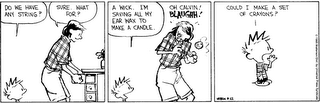
This post is not suitable for those with delicate sensibilities. I just love today's Calvin & Hobbes cartoon! Just in case you have trouble reading/opening it, Calvin is collecting his ear wax to make a candle and, when his mother expresses disgust, he suggests crayons as an alternative. While I fully understand Calvin's mother's reaction, to me this cartoon typifies the gradual way in which adults impose limits on creativity.

We all know that "kids say the darndest things", but how do we handle it when they do? At least Calvin's mother didn't have to share this moment with the general public! I remember as clear as if it were yesterday, one of my sons (please tell me he doesn't read this blog) standing on a chair in Macdonalds (other heart attack factories are available ;-)) and announcing very loudly "I made a fart!". It was one of those parenting moments that happens to us all - we know it's going to happen and yet we're still completely floored when it does. Sadly, our attempts at gentle, mature, wise handling of situation were completely ruined by the fact that we were weeping with laughter and utterly unable to get the words out. Yeah. That was going to discourage him from doing that again. That was going to instill an understanding of propriety. Sure. Right.

When I was studying teaching methodology at college, we looked at this very subject and one of our text books (I would love to reference it properly, but can't for the life of me remember anything about it - it was over 20 years ago, after all!) contained an anecdote related by a school inspector:

He was visiting a class of 5 year old children who were engaged in a project of drawing their homes. Most of the kids drew the usual box with a red roof, smoking chimney and cottage windows. One child had drawn a series of connected boxes that seemed to make no sense at all until she explained that it was an aerial view of the house with the roof removed (a budding architect?). "There's my room, there's the baby's room, there's Mommy and Daddy's room, and there's the bathroom with Mommy on the toilet." The teacher blushed. "I don't think so," she laughed nervously and tried to persuade the child that the picture represented something else altogether. After a while the child, showing remarkable insight, realised that the teacher was uncomfortable and sought to put her at her ease, "Oh it's alright," she said, "the door's closed!" The inspector experienced regret that the teacher had focused on propriety and her own sensibilities, rather than the child's display of cognitive ability, creativity, imagination, perspective and the rest of a long list of skills.

When I was a student, I taught drama part-time to pay the bills. My youngest group was 5-6 themselves. Some of the anecdotes these little ones related and the improvs they did were very revealing of details I'm sure their parents would far rather have kept private. I was only 19, so I'm sure I blew it repeatedly, but today's cartoon reminds me that children's imaginations are not restricted by what is "proper", and both teachers and parents need to handle the situation gently to ensure that, as they come to terms with acceptability, they do not experience a sense of condemnation of their efforts and, by extension, themselves.

And are we so very different, we adults, with our maturity and perspective? We pour our hearts and souls into some or other effort which the client then proceeds to rip to shreds. Do we not feel those criticisms as if they were of ourselves? No? Just me then!

Friday, August 18, 2006

Wikipedia - an inherent risk

Via George Siemens, here is a wonderfully ironic tale about Wikipedia. To summarise: Dave Snowden amended the entry on Knowledge Management, including references to some of his own work, only to have his amendments "corrected" by someone (he has dubbed Clint) who asserts that he (Snowden) has never read Snowden's work.

Whoops. The words egg and face come to mind. I can't help hoping that this little tale finds it way back to "Clint" (although, being an opinionated old bat, I have been in his shoes more than once), not because of schadenfreude, but so that he can adjust his own understanding and allow Snowden's amendments to stand.

This tale highlights an inherent risk of resources like Wikipedia (and any social media) - as Snowden says "Clint has more energy for this than I do". People with the time, energy and inclination will get their take on things out there more often and more "loudly" than those who might have a more accurate understanding but who, for whatever reason, don't avail themselves of the forum as assiduously.

In this week's summary email, George says: "Wikipedia is essentially encouraging "critical thinking"". Without this critical thinking, we might be inclined to accept Clint's take on knowledge management and subscribe blindly to his view that Snowden has never read Snowden's work. Increasingly, the onus is on us to double check our sources and find corroborating evidence of claims made. We can't afford to hide behind "I read it in Wikipedia, so it must be true".

Thursday, August 17, 2006

Did you know?

Via David Warlick, this post from Karl Fisch, containing an interesting PowerPoint presentation of "did you know" type facts. It makes for interesting viewing, even just from a fact-collecting perspective, but it's the sort of information that should be having an impact on the way we address learning in general, and education in particular. The sequence of slides that I found most telling was:

  • The top 10 in-demand jobs in 2010 didn't exist in 2004
  • We are currently preparing students for jobs that don't yet exist...
  • Using technologies that haven't been invented...
  • In order to solve problems we don't even know are problems yet.

Wednesday, August 16, 2006

Learning by doing

I came across this review on Educause recently of a book that glories in the pithy title of: Learning by Doing: A Comprehensive Guide to Simulations, Computer Games and Pedagogy in e-Learning and Other Educational Experiences. The author is Clark Aldrich, and the publisher John Wiley and Sons (2005). The review (by Deborah Keyek-Franssen - a new name to me) is well written to the point that I would like to get my hands on a copy of this book, but find the price tag a little prohibitive.

I have to say that I am already convinced of the pedagogical value of games and simulations. What I am currently looking into is their andragogical value (although I get the impression that the word is falling into disuse and that pedagogy is becoming the generic term covering both bases). I have been toying with the notion of inlcuding games/simulations in a blended learning solution for adults, but many of the simulations I have seen are somewhat trite (mind you, the same can be said for many of the quizzes on e-learning materials). I realise that any game/simulation will have to be both engaging and effective. At a recent conference, one of the speakers expressed the view that games and simulations should afford the opportunity to put the learning into practice or to assess learning, and should not attempt to teach. I thought this was an interesting viewpoint and one that may well have some validity for an adult audience. However, I'm still just at the exploring stage. Much remains to be seen.

In the meantime, I shall have to see if my library has seen fit to acquire a copy of Aldrich's book.

Tuesday, August 15, 2006

Book meme

I haven't traced it all the way back to the start, but Barbara Ganley and Chris Sessums are involved in a book meme, which is quite revealing. It puts me in mind of Kathy Sierra's excellent and thought provoking post some time back (12 Feb, to be exact) about what was on her virtual coffee table. Kathy writes as I imagine she speaks, so I had felt as if I knew her pretty well for some time, but that list of books was the clincher. When you know what a person reads (and why), you know an awful lot about a person. While Kathy came up with a list of her favourite books in no particular order, the meme that Barbara and Chris are contributing to is structured, and I can't decide whether that makes it easier or tougher.

Their challenge looks like this:

  1. A book that changed your life
  2. A book you've read more than once
  3. A book you'd take to a desert island
  4. A book that made you laugh
  5. A book that made you cry
  6. A book you wish had been written
  7. A book you wish had never been written
  8. A book you're currently reading
  9. A book you've been meaning to read
  10. Tag five people you want to hear from
It's a thought provoking list, rather like one of those ice-breakers where you are asked to list five people (living or dead) you would like to have around your table at a dinner party. I'll be interested to follow this and see where it goes and what it reveals about the people I read. Ooh - that sounds a bit voyeuristic, doesn't it? I feel a bit like a snoop, now!-)

Learning while under fire

There's an interesting post from Mark Oehlert today about soldiers on active duty learning and adapting in order to stay alive (and presumably try to win the conflict). He links to an article on the FCW website. This harks back to an earlier post of mine about learning under pressure, and to a conversation I had with Vicki Davis on one of her posts.

Monday, August 14, 2006

Back to the grindstone

I have been away from work for a week, having a little break. Our boys were away at a youth camp wth 5000 other teenagers, so my husband and I went to a B&B in Cambridge (a mere 1 hour drive away) for a long weekend's R&R. We left our laptops behind, so we could unplug and unwind. When the boys returned from the camp, we spent a few days together as a family, which was really great. With the recent disruption to the flights out of the UK, I am only too pleased that we didn't try to do anything more adventurous or exotic.

Today, I got back to the office and online. Of course my Bloglines hadn't been on holiday, and there were more new posts showing there than there were new emails in my Inbox. I haven't even bothered thinking about what that says about the balance of my life!

Of course, I couldn't read them all properly, but was grateful to rate a mention from Stephen Downes and a complimentary shoutout from Vicki Davis in my absence (actually, Vicki's post focuses on the value of comments on blog posts, and is well worth the read, especially for new bloggers). I skimmed through the list of posts, skipping several , scan-reading some and slowing down to read a few. I identified that Blackboard's patent is still causing waves. I have downloaded Stephen and George's discussion for a listen when I get my head above water (they will no doubt go way beyond my fighting weight, but it'll be a stretching exercise for me). I briefly toyed with the idea of taking up Will Thalheimer's challenge to "prove that taking learning styles into account in designing instruction can produce meaningful learning benefits", but decided I have neither the time nor the resources.

A final note: During my week off, I seem to have gained another subscriber albeit a private one, which gives rise to a question: what would be the sort of reasons that a person would choose to be a private subscriber? It's not meant peevishly - I'm genuinely curious. Maybe you have a few ideas. Maybe you're one of the private subscribers and would be willing to share your thoughts (anonymously of course, if you prefer). I think it would deepen my understanding of the levels of participation and consumption of the blogosphere.