As a sports lover, I have been delighted at the growing success of the England women's cricket team. And, with the hard-fought, longstanding Ashes just around the corner, tension is mounting! I would say that the ladies' team stands a better chance of winning the Ashes than their male counterparts.
If you're more familiar with baseball, Wikipedia has a nice comparison of the two sports.
My one and only attempt to play cricket was during my school days. It was part of a fundraiser to help the local hospital buy a dialysis machine, so that a lad from the boys' school would no longer have to travel to a neighbouring town for treatment three times a week. We staged a sponsored boys'-school-versus-girls'-school match in every sport on offer at the two schools. When I went out to bat for the girls' team, I was very confident. Huge restrictions had been placed on the boys and I was a dab hand at rounders, so this was going to be easy. Ha! One moment, the bowler was running up to bowl. The next, I was making squeaking noises behind the wicketkeeper, and he, somehow, had my bat! Not my finest moment.
The English women's captain, Claire Taylor, by contrast is a consummate sportsperson - the first woman ever to have been named one of Wisden's five cricketers of the year. There have even been whispers that she may be considered for selection for the men's national team. Of course, they are just rumours at the moment. While she was the leading run-scorer in England's victory in the Women's World Cup, facing up to the pace generated by male first class cricketers is - for now, at least - a very different prospect from that of their female counterparts, and she would be up against stiff competition for her fielding role of wicketkeeper. But let that not detract from her achievements in the women's game.
As if to balance out all this sporting prowess, she is also a skilled violinist with an orchestra in her home town of Reading.
Women wear pretty much the same kit as the men, and questions abound about jockstraps, boxes and breast protection. I have researched the matter on the web and am none the wiser. The previous women's captain, Clare Connor, is on record as saying women wear no protective gear in these areas... and she spoke from the position of one who had been painfully hit in the groin. But that was in 2003. During a (men's) match in 2007, one of the commentators said "I saw Rachel Heyhoe-Flint asked this question once by a really smirking TV pundit," says Tom Adam. "She wiped the smirk right off his face by answering, absolutely dead-pan, 'Yes, we wear boxes, we call them "man hole covers".'
Charming.
On a more uplifting note, female cricketers have, for the past few years been able to wear kit designed for them, rather than having to make do with men's trousers and the like. And, in 2008, Adidas came on board with specially designed kit for the national women's teams.
Learn more about the women's game here.
Tuesday, July 07, 2009
LPoD - Women's cricket

Monday, July 06, 2009
LPoD - brains and seahorses
When we visited Spain a couple of Easters back, we stayed in a hotel called Hippocampo. I was tickled at how similar that sounded to the part of the brain called 'hippocampus'. Since I spoke no Spanish and noticed several other hotels and apartment blocks with the same word in the name, I assumed it was the surname of the owner of the chain or the holding company or something along those lines.
It gradually dawned on me that the seahorses which appeared everywhere were no coincidence. I looked up the word seahorse in the phrase book and confirmed my suspicions. Hippocampo = seahorse.
Now that I knew this, I was tickled that an area of the brain should have a name that sounded like the Spanish for seahorse.
Today I discovered - well duh! - that the hippocampus is so called because of its resemblance to a seahorse.
Doh!
Monday, June 22, 2009
lpod - what we don't know about childbirth
I know it's been a while since I did one of these, but this was my learning point for today.
Because I'm a sad person (or so my family tells me), I listen to talk radio when I have the car to myself. Today was one such day and I listened to a programme about premature babies (the link will be available for 7 days - apologies if the BBC link doesn't work outside the UK). Comparatively little research is done in this field and there are still huge areas of blankness.
Unless a woman has already miscarried or given birth to one premature baby, there is still no way of knowing whether she is at risk of doing so. So a couple will have to have dealt with all the associated difficulties at least once before they are referred to a unit which will monitor subsequent pregnancies. The interviewer asked the expert what starts a woman off in early labour and (and this is where the learning point comes in) it transpires that we still don't know what starts labour at any point, early or otherwise. No-one knows yet what the catalyst(s) is/are that start the process.
The immediate instinct when a woman goes into early labour is to try to stop it. Very few effective means exist to achieve this. Quite often, it transpires that the uterus has become a hostile and/or toxic environment for the child and the risks of early birth may be less than the risks of a prolonged stay in that environment. So it's a trade-off and we don't know enough to be able to make that decision quickly and reliably.
Rather tellingly, it has only been in the last few years that UK birth records have begun to record gestation instead of just birth weight, so there is precious little recorded data to go on prior to that. As a result, it isn't possible to compare the statistics around premature births with other countries.
Interesting, huh?
Okay, so it's just me. Sorry.
The programme kicked off and ended with an interview with a woman called Sarah and her daughter Isobel who had been born at gestation 27 weeks (so 3 months early) in 2001. I was stunned when Sarah shared how people immediately assume that the early birth of her daughter was somehow her fault: as if she hadn't looked after herself properly, or had engaged in substance abuse of some sort. I have known many people with preemie babies and have never heard anyone respond to them with such an assumption.
What was utterly heartwarming, though, was Sarah's evident pride in her daughter's ability to walk, something she was expected never to do. Issy has a catalogue of disabilities, but Sarah takes pride in the things she is able to do, instead of bewailing the things she cannot. As the programme ended with the joyous laughter of mother and daughter as Issy bounced on a trampette, I chastised myself for my disappointment when my boys don't live up to my expectations.
We also heard from a couple whose (as yet unnamed) son was born two-and-a-half weeks ago at gestation 25 weeks. Their whole world has reduced down to the size of the neonatal intensive care unit. They hover over his incubator and celebrate things like a 20g weight gain. As the mother tried to explain how she treasured things like being able to change his tiny nappies, and gave up as her voice failed her, I realised again how very, very fortunate I was to have given birth to three live, healthy, term babies.
Go give your kids a quick squeeze. I did as soon as I got home.
Monday, April 20, 2009
LPoD - a horse of a different colour
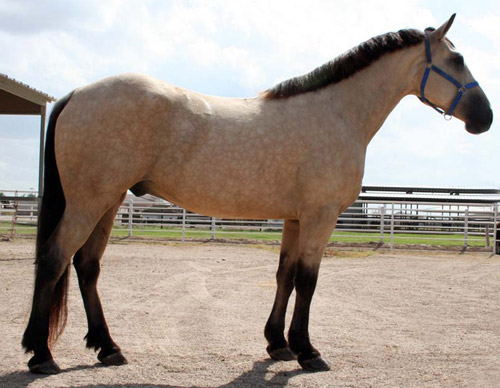
Having posted a photo of a spotted horse for today's pic of the day, I decided to find out what the proper term was for such a horse. According to this article, it is a leopard appaloosa.
I didn't realise how many different named varieties there were. I'm glad I looked it up, too, because I learnt something else. There is a certain colouration that I have always loved, but I have never known what to call it. No-one I have asked has been able to help me, either - not even horsey people (obviously my description left much to be desired!). But this article tells me that my favourite horse colour is a palomino, closely followed by a buckskin.
Friday, April 17, 2009
LPoD - Marjorie Latimer and the coelacanth
This is a demonstration of something I told Graham Wegner yonks ago, when he was dissing his 'ordinary' home town of Adelaide, Australia. I pointed out that what to him is ordinary is most exotic to the rest of us. Well, the time has come for me to realise that this applies to me, too!
I have always been most scathing about the city in which I lived from the age of 10 until I left with a sigh of relief at 24. I once told my mother (who still lives there, along with most of my remaining family) that it was the *rse end of the earth, to which she retorted, "Well, it's a good thing you're just passing through, then!" Can you tell where I get my sense of humour from?
And then it came to light during a Twitter conversation today with Zoe Rose, aka Coelacanthro, that something that had formed such an integral part of the tapestry of my life was actually something very exciting and of global import.
Just off the coast of East London (that's a city on the east coast of South Africa, not a region in the capital of England), in 1938, a coelacanth was caught. So what, you might say. So what, indeed! This was a fish with 'legs' that had been thought extinct for some time. It was hailed as a living dinosaur, although it actually predates dinosaurs by several million years.
The woman who made the discovery, in amongst the catch of a local fisherman, was Marjorie Courtenay-Latimer, who was then the curator of the city's museum (let's not just skim over the realisation that this was a woman holding down a senior position before the second world war!). She didn't know what the fish was, just that it was almost certainly important. The find was confirmed by Prof. JLB Smith of Rhodes University, in Grahamstown. When I say it like that, it does no justice to Courtenay-Latimer's persistence. Smith was not an easy man to contact, or to engage, and several others had already told her that the fish was just a grouper.
However, once Smith was engaged, he was totally committed to the project of the 'living fossil'. When another coelacanth was caught off the Comores in 1953, he kept it in a box beside his bed all the way back home. It must have been a little niffy, to say the least!
The coelacanth still holds pride of place in the East London museum, as far as I know. I have seen it so often that it was only today that it dawned on me what a privilege it was to have such ease of access to such a unique specimen.
I once met Marjorie Latimer, albeit fleetingly, when she came to watch a show in which I was appearing in the local theatre. She was quite a feisty woman, considered something of a national treasure by the locals, who lived to the ripe old age of 97, dying in 2004.
Her life and mine had another rather odd overlap. When we visited East London in 2001, my mother gave me a rather large sum of money with the strict instructions that I was to spend it on a beautiful piece of jewellery (she becomes quite exasperated at my reluctance to spend money on myself). I went to a local jewellery designer, who was busy making repairs to a titanium coelacanth brooch he had made for Latimer's 90th birthday some years previously. He proudly showed it to me. Sadly, the coelacanth is not really a pretty fish, so it does not lend itself easily to design, but I'm sure that Latimer was tickled pink to have it, because of its significance in her life. And it must have proved successful, because the designer has gone on to create a whole range of coelacanth (and dolos - but that's another story) jewellery.
You can find a more complete account of the story here, and of course, wikipedia can tell you more about the dinofish itself. This site is also an excellent source of information and images for those interested in the topic.
Wednesday, April 08, 2009
pic of the day - blood

A friend of mine is encouraging me to consider becoming a bood donor. He invited me to come with him tonight when he gave blood. It's undeniably a good thing to do, and my mother and both her parents gave blood for as long as they were allowed to. But, I don't do well with needles and I mean, look at that one - it's like a flipping yoghurt straw!
LPoD - UK toilets
Okay, this is not really a learning point for me. Consider this a public service post.
Apologies for the return to the Jeff Dunham theme, but last night he revealed that he was perplexed by English toilets. It was rather reminiscent of that moment in Demolition Man, when Sylvester Stallone, aka John Spartan questions the 'three seashells' which have replaced the toilet paper of his own day.
So, because I have no qualms about discussing such matters, just in case any other Americans (ahem, Mrs Vicki) are planning to make the trip across the pond, I thought I'd give you a heads up.
In the UK, all newer toilets in private homes and public loos (erm... bathrooms - have never understood why they're called that when there is no bath), are fitted with a two-button flush device instead of a single handle, or hand wave sensor thingy (how I hate those - they always go off and the most inconvenient moments!). This is a requirement. I'm not sure at quite what level this requirement has been set, but if you stay in a hotel or visit a public convenience, you will almost certainly be faced with this mystery.
One button will always be larger than the other. The large button will result in a full flush, emptying the entire cistern. The smaller one is one you have to hold down for as long as necessary for each occasion. A user-controlled flush, if you like.
I leave it to you to figure out when you might need to use which. I realise there are limits to what you would be comfortable reading here.
The reason for this is that it saves water. Europe is far more focused on environmental issues than many American citizens are accustomed to, it seems to me (no offence, or anything).
As I'm writing this, I can think of all sorts of learning design analogies, but I guess that might be pushing your tolerance too far, as well, so we'll leave it there, shall we?
Friday, March 27, 2009
LPoD - a bubble bursts
Thanks to a tweet from Claudia Ceraso, aka fceblog, I viewed this video today. It features Kevin Murphy, a lecturer from Ithaca university and proposes a whole new interpretation of one of my all time favourite poems, Robert Frost's The Road not Taken. True to his title, Murphy does deliver a lecture. Not even chalk and talk. Just talk. And he doesn't move from his spot behind the podium. If, therefore, you have a short attemntion span and/or you don't have a deep interest in the poem, skip straight to the end of this post.
It puts me in mind of the song Every Breath You Take by the Police. It is one of the most popular first dance choices for newly married couples. What none of them seem to realise is that this is not a song about deep and abiding love. It's a song about an obsessed spurned-lover-turned-stalker. I kid you not. Listen to the lyrics. According to one article I read, even the artists are baffled that people could misinterpret the song so completely.
In much the same way, I feel as if my comfortable illusions about Frost and this poem have been shattered. But Murphy mounts a compelling argument.
Thoughts?
Tuesday, March 24, 2009
Monday, March 23, 2009
Bonus learning point of the day - spikes
I have just returned from a fruitless trip to the local sports shop. I was looking to buy replacement spikes for both my son's javelin and sprint spikes. The man behind the counter is obviously a keen road runner but he doesn't really know a lot about sprinting or javelin. The spikes he was trying to sell us didn't look anything like the kind in my son's shoes. He didn't have long enough spikes for the javelin shoes and he didn't have anything of the same shape as the sprint spikes.
I came back home and went googling (as you do), and was fascinated to learn about the spikes he uses in his sprint shoes. They're called Christmas tree spikes. There's no way I could do anywhere near as well as this article, so check it out for yourself if you're interested in sprints or if you're kitting out a son or dauther who sprints.
LPoD - crate training
Today Jessie and I attended the final session of her puppy obedience training programme. She has been passed worthy of joining the adult dogs from next week. There remain a few issues that we struggle with and, on the advice of the animal behaviourist who assessed her progress today, we have decided to try crate training.
Until quite recently, if I had seen a dog in a wire cage, I would have thought the owners very cruel indeed. So learning about this training approach has been something of a challenge for me. I have decided that I am willing to give it a go, as long as I am not ever expected to inflict on her any treatment that she finds traumatic.
All sources emphasise that the crate is never used for punishment, but that the dog should see it as a safe place where it can retreat to. There should always be a comfy mattress, water and a treat or activity in the crate for the dog. Some recommend covering the crate with a blanket to make it seem even cosier. Most wild canine species seek a den for sleeping, and the crate represents an equivalent of this. I never thought of it this way before.
Until the dog is happy to enter the crate, and regards it as a safe space, the door to the crate should be left open.
The crate should never be used as a long term confining space for the duration of (for example) an owner's working day.
Crate training can be used as an aid in toilet training. Dogs do not usually toilet in their own sleeping space. Placing their bed inside a crate will mean that the dog will wait until released before toileting, giving the owner greater control over this aspect. However, if the dog is confined to the crate for such a long period of time that it is forced to toilet inside the crate, this will set back the toilet training by several months.
All sources seem to recommend not giving the dog free run of the house until it is properly toilet trained. Before then, the dog should only be allowed the run of the house for short periods when you know that both its bladder and its bowel are empty.
Once a dog has been crate trained, transporting can be done by means of the crate. In our case, since Jessie is a large dog, transporting her crate will present a logistical challenge not presented by transporting her uncrated, so we probably won't use the crate as a means of transport.
Since she is nervous of things like buses and compressors coming close, I suspect she may prove to be afraid of fireworks. Come 5 November, I suspect her crate will prove a safe haven for her to retreat to.
Assuming, of course, that the whole exercise proves successful!
Sunday, March 22, 2009
LPoD - dichroic glass
Today's learning point relates to the bracelet I received for mothers' day. It is made of beads of dichroic glass, which appear to change colour, depending on the angle at which you view them.
Dichroic coating was originally developed by NASA for the aerospace industry. The material is used in the visors of space helmets. I have also heard some reports that it is used in the Hubble telescope, but I have been unable to verify this. The glass contains microlayers of different metal oxides, applied using an electron bombarder inside a vacuum chamber. These reflect and refract light in different ways, resulting in the effect of different colours when it is tilted this way and that. In fact, no color is actually produced. The perceived colours are the result of light manipulation.
It is now very popular in costume jewellery design and manufacture, as much because of the price tag as the depth and range of colours. Because the reflection/refraction cannot be accurately predicted, no two pieces of dichroic glass are ever exactly alike.
Here's an example, picked at random from the many returns from a google search.
Friday, March 20, 2009
LPoD - mushrooms and cancer
According to an article my husband ripped out of a free London newspaper, "eating a daily portion of mushrooms could cut the reisk of breast cancer by up to two-thirds".
The article cites the International Journal of Cancer. According to this article from the BBC, combining this consumption of mushrooms with a regular intake of green tea can reduce the chances of breast cancer by up to 90%.
However, Dr Sarah Cant of Breakthrough Breast Cancer sounds a note of caution:
"Breast cancer incidence rates do vary in different countries and China has lower rates than the UK."However, this is likely to be due to cultural and lifestyle differences such as having children earlier or exercising more for example, and is unlikely to be solely due to diet.
"We still aren't sure which individual food types influence the chance of developing this disease."
The research findings seem to have been picked up by several major newspapers, each of which pick up a different slant on the story.
In the meantime, I'm more than happy to eat 10g of mushrooms a day.
Thursday, March 19, 2009
LPoD - red tape
Today's learning point concerns Swedish passports. Our sons both have Swedish citizenship (although they speak barely a word of the language) and their passports have now expired.
In addition to the usual falderal associated with getting a new passport, Sweden doesn't allow dual citizenship - if you want to carry a Swedish passport, you are not entitled to carry any other.
In order to obtain a replacement Swedish passport, the applicant must demonstrate that s/he does not carry any others. This means (in the case of Swedish nationals in Britain) submitting a form to the British Home Office requesting confirmation that the applicant has not been granted British citizenship. This confirmation must accompany the application submitted to the Swedish consulate.
Monday, March 16, 2009
LPoD - menopause bread
For those 'women of a certain age' among us (what a ridiculous phrase - how many women are of an uncertain age?), here is a recipe for 'menopause bread'. According to this article, scientific research shows that soya and linseed reduce the instance of hot flushes. Don't you just love it when they tell you 'scientific research says...' but don't cite their source? Especially when this article says
"the research hasn’t lived up to the early promises. There is no consistent evidence that soy reduces the severity or frequency of menopausal symptoms (like hot flushes) or reduces breast cancer."What the heck - I'm willing to give it a go! Anything to stave off the need for HRT which has been linked to breast cancer, for which I am in the high risk group, all three of my Dad's sisters having had the disease, with only one survivor. Ironically the only survivor developed the disease earliest, when she was the age I am now!
Later edit: 18/03/09 This recipe doesn't work in a bread maker. You have to do it the old fashioned way. I tried to take the easy way out. #Epicfail.
I take no responsibility for the imperial measurements, which seem inconsistent to me - those are the quantities I was given.
100g (4 oz) soya flour
100g (4 oz) wholemeal flour (may be replaced with buckwheat or more rolled oats)
100g (4oz) rolled oats
100g (4 oz) linseeds
50g (2 oz) pumpkin seeds
50g (2 oz) flaked almonds (or other nuts)
50g (2 oz) sunflower seeds
5 cm (2") piece of stem ginger, peeled and finely chopped/grated
225g (8 oz) raisins/dates/cranberries
1/2 teaspoon nutmeg
1/2 teaspoon cinnamon
1/2 teaspoon ground ginger
425ml (15 fl oz) soya milk
1 tablespoon malt extract
Sift all dry ingredients into a large bowl. Add soya milk and malt. Mix well and leave for about 30-60 minutes. If the mixture is too stiff, add more soya milk until you achieve a dropping consistency.
Heat the oven to 190C (375F/gas mark 5). Line a small loaf tin with baking parchment. Spoon the mixture in and bake for about 60-90 mins until a skewer comes out clean when inserted.
Turn out and cool. Eat one thick slice every day.
Friday, March 13, 2009
LPoD - South African visitors to the UK
Who says Facebook isn't a learning tool? One of my FB friends, a fellow South African ex-pat, most of whose family is also still back there, posted some information on her page that has become today's learning point.
Essentially, it seems that the UK issued an ultimatum to several countries to tighten up security around the issue of passports (you may remember that I recently posted that during 2007, 6000 Chinese nationals are said to have entered the UK on genuine South African passports obtained 'under the counter' for £5000 each). It seems many of the other countries affected such as Botswana, Brazil, Malaysia, Mauritius, Namibia, Trinidad and Tobago took heed. South Africa, it appears, did not.
As a consequence, all South African nationals will now need a visa to enter the UK - even just for a holiday. Apparently, according to a South African based immigration group called 1st Contact the process of obtaining this visa is cumbersome and lengthy. Also according to 1st Contact,
There is also a newly introduced bio-metric component attached to this new regime. It has been alleged that South Africans will be required to complete a 10 page application form, incur fees anywhere from £ 65 (for holidays Visas) to £ 600 (for business Visas) and then still make their way to VFS (Visa Facilitation Service) office, for finger printing and retina scans. The biometric scans are then sent to the British High commission along with the application to review, before the granting of Visas takes place.Some of these measures have already been introduced, with the balance expected to be in effect in mid 2009.
Historically South Africa has made up the 5th largest tourist group in Britain. According to an article published in the BBC, in 2007 419 000 South Africans legally visited the UK, comprising of 168 000 tourists and 46 200 business visitors, where over 3000 South Africans were even granted work permits.It seems the point of these measures is not to curb the number of South African visitors, but to strengthen the UK's borders. However, many South Africans, and other Commonwealth citizens are expressing a different view under their breath. Now that several eastern European countries have joined the EU and their citizens can legally move to the UK without the need for visas, the number of immigrants from these countries has rocketed. Since the UK is powerless to change this, there are those who feel that the UK government is taking what action it can, and that Commonwealth countries are the chosen target. I'm not prepared to make that judgement one way or the other, just yet.
The immediate effect for me is that the cost of these visas is very high when you're paying for them in Rands, currently at a little under ZAR14 to the Pound. This effectively means that the once slim chance that members of my family may be able to visit us in the UK is eradicated. And since we were hoping for a gathering of the clans to mark our elder son's entry to adulthood later this year, this is a heavy blow for me.
My mother has implied that she would be prepared to come over and 'do' for me, should I have to undergo surgery to my neck (which unfortunately seems to be indicated at present), but I suspect that her offer might have to be withdrawn under these circumstances.
Wednesday, March 11, 2009
LPoD - Narrative inquiry
I wish I could write enough about this point to reflect how much I have been thinking and learning about it lately. It isn't really the learning point of a single day. It is an on-going process. Because I am adopting a (first person) narrative inquiry approach for my dissertation, I have been trying to find out as much as possible about it.
This is the way I go about things. I didn't know that there was an established methodology called first person narrative inquiry. I just felt very strongly that this was the right way to go about presenting my work. Only once I was defending my case to my dissertation supervisor did I learn that others had trod that path afore me. She sent me in search of materials to reference in my rationale.
I came across a few choice pieces:
Clandinin, D Jean and Connelly, F Michael. 2000. Narrative Inquiry - experience and story in qualitative research. Jossey-Bass. ISBN 0-7879-4343-6.
Farrands, Robert Miles. 2007. Excitement, bewilderment and emergence: exploring a life world through writing as first person inquiry
Whitehead, Jack. 1988. Creating a living educational theory from questions of the kind, 'How do I improve my practice?' Cambridge Journal of Education, Vol 19, No1, 1989, pp 41-52. Accessed online 12 November 2008.
As I have been reading these, I have become enthused all over again for the narrative approach. I was excited almost to the point of tears (pathetic, isn't it?) by the title of Whitehead's paper, because this is exactly the question I have wanted to explore in respect of my own professional practice: How has the use of social media affected my professional practice? In particular, I want to look at it from a learner's perspective, since altogether too much research addresses the teacher's perspective.
There are great wadges of text I would love to lift right out of Clandinin's book, but that would leave little place for my own writing in between! Take for example, these gems:
"Educators are interested in life... learning and teaching and how it takes place...the leading out of different lives, the values, attitudes, beliefs, social systems, institutions and structures, and how they are all linked to learning and teaching"Can I get an Amen? Tell me I'm not the only one who wants to stand up and cheer... please?
"For Dewey, education, experience, and life are inextricably intertwined. When one asks what it means to study education, the answer - in its most general sense - is to study experience."
"People live stories, and in the telling of these stories, reaffirm them, modify them, and create new ones. Stories lived and told educate the self and others, including the young and those such as researchers who are new to their communities."
"People are individuals and need to be understood as such, but they cannot be understood only as individuals. They are always in relation, always in a social context."
And, of course, because I think in analogies, this immediately brings to mind a vivid image for me. Because research tends to pick a narrow focus, you get a whole load of in-depth, highly detailed pictures, like exquisitely wrought beads. But narrative inquiry provides the string that turns those beads into a beautiful necklace. Each bead has its place among the other beads, and each either complements or clashes with other beads on the string.
My head is brimming and buzzing with stuff on the subject, but I think I'll do a more complete exploration in the dissertation itself.
I'm such a geek. This stuff really gives me such a buzz!
I know I've said it before. It isn't about the learning. It's about the learner. The person.
Contented geeky sigh.
Tuesday, March 10, 2009
LPoD - teenagers and their sleep patterns
Fascinating! I just happened to be driving back from Oxford today in time to hear a radio interview with a Dr Paul Kelly regarding recent research into teenage sleep patterns. Kelly referenced this programme on the BBC, in which he appears (hopefully this will be available to non-UK residents - please let me know if this is not the case).
The research question was something along the lines of: are teenagers just lazy or is there a physiological explanation for their tendency to sleep until 11am?
It seems that, from the onset of puberty until the age of 21 in boys (19.5 in girls) there is a genuine physiological shift in their body clocks which results in a change in the pattern of the release of melanin into their bodies. At around 10am, the hormonal shift from sleep to wakefulness starts to kick in.
Kelly was talking about a school which plans to shift its school day to run from 11am-5pm instead of 9am-3pm.
Of course, there was an instant outcry from the listening public who opposed the idea. With the show being aired during working hours, you can imagine that the bulk of the listening demographic comprises pensioners, most of whom were thoroughly indignant, it seems. There was a lot of "When I were a lad" and "Never did me no 'arm". Teenagers were roundly criticised for being lazy and out of touch with the real world. Only one woman - the mother of 3 teenagers - dared support the idea.
If there is to be resistance to the concept, I would prefer to see it based on sound reasoning, rather than "that's 'ow it's allus bin done". One opponent did cite the logistical issues around teachers' working hours and child care issues, which would obviously have to be considered.
As the mother of two teenagers, and, as an erstwhile teenager myself, I would have to say that my observations are as follows:
- My husband and I have always been night owls, preferring to stay up late and sleep in, whenever possible. We're not teenagers any more (you'll be astonished to learn), so are we anomalous? On the other hand, we are able to rise at a 'respectable' hour and function normally, whereas it seems that teenagers demonstrate a quantifiable improvement in cognitive ability later in the day.
- Our elder son has also always been something of a night owl. Since he turned 16, he no longer has a bedtime. However, we do find it necessary to stick our heads around the door and say, "Erm, Sweetheart, it's almost midnight and you have a first session tomorrow. I suggest you get your tail into bed."
- Our younger son was the solitary lark in the family. While the rest of the family was deep in blissful slumber, he was ready to start the day with a smile and a twinkle. I have a niggling worry that our grunted "Unh-unh!" at him every morning has done damage to his psyche, since he lacks the easy self-assurance of his brother. Be that as it may, with the onset of puberty, even our lark has taken to lie-ins whenever possible.
As the interview progressed, I could picture in my occasionally photographic mind just about every exam timetable my kids have ever had. Almost without exception, the start time for their exams has been 9am. So not only do we have a ludicrous system for assessing a child's competence in any given subject, the mechanism is scheduled to take place at the worst possible time for our teens. Hmm.
From my own perspective, I have no problem with moving the teenager's day forward by two hours. Of course, I'm not a teacher, whose life would be disrupted by this change.
Tuesday, March 03, 2009
LPoD - starting blocks
I have probably mentioned this more than once before, but, in my youth, I was a 400m sprinter. As was my husband. Not surprisingly, we have spawned a sprinter in our elder son. At the moment, his distance of choice is 200m. Fortunately he runs a good bend - absolutely critical if you're a 200m sprinter!
When my husband and I were competing (not against each other, of course), it was practically unknown for athletes of our age to use starting blocks. In fact, it was quite common for kids to run barefoot (remember Zola Budd? It was Africa, after all!).
Nowadays, even teenage sprinters use starting blocks when they run for a club. Our son has had to learn to set his blocks - something we were unable to advise him on. This was a new experience for us. Between us, we have been able to advise him on almost every other aspect of his sprinting: faster starts, best lanes, better strides, improved arm movements, shortening the bend, leaning into the bend, breathing, focusing the eyes, relaxing the neck and face so as not to divert energy from the arms and legs, head position, keeping your rhythm... you name it.
So we have been fascinated at this new arena. It seems that this is how a simple approach to setting your starting blocks:
- Place the knee of the rear leg opposite the instep of the front foot
- Move forward with the hands until the body weight is directly over the hands and the arms are vertical
- Ideally the angles of the legs in the "set" position should be: leading knee 90 degrees, rear knee, 120 degrees.
Take your marks....!
Monday, March 02, 2009
LPoD - Happy birthday Dr Seuss
I didn't know that today was the 105th anniversary of Dr Seuss's birthday. But that's the beauty of social media. I discovered this nugget on one of the blogs I read on a daily basis. I have to chuckle at Jeremy's poetic tribute, although those less familiar with the current state of affairs in South Africa might not 'get it'.