Thursday, September 07, 2006

Tim Berners-Lee and the Emperor's Web 2.0

I haven't been doing much posting lately, for reasons I have already explained, but I have continued to be a consumer, and was sufficiently galvanised by this item about Tim Berners-Lee's take on Web 2.0. He is reported to have said that Web 2.0 is "purely a blog and wiki thing".

Tim Berners-Lee, the individual credited with inventing the web and giving so many of us jobs, has become the most prominent individual so-far to point out that the Web 2.0 emperor is naked. Berners-Lee has dismissed Web 2.0 as useless jargon nobody can explain and a set of technology that tries to achieve exactly the same thing as "Web 1.0."
At the risk of sounding like an iconoclast, I don't believe that the enormous contribution that Berners-Lee has made, means that his view is automatically definitive. I'm not necessarily rejecting what he has to say, but his baby is all growed up, and other people's perceptions may well have just as much validity as his own. I know that George Siemens shouted a loud hurrah. It will be interesting to see what other responses are evoked.

Thursday, August 31, 2006

Attitude and Health: Bloom and Maslow

Things really got on top of me recently. Too many commitments, too little time, one or two conflict situations and no support mechanism. (This, by the way, has proved easily the toughest aspect of emigration: the loss of the extended family and network of friends.) I was aware that I was taking strain, but thought it would pass as it has before. Then, on Tuesday, I was on the phone to a colleague discussing a difficult situation facing us, when I suddenly started to shake fairly violently and was unable to stop for some time. I took myself off to the doctor who (no surprise) diagnosed stress, tension, anxiety. He offered chemicals, which I declined, preferring to find an alternative route.

So why am I sharing this obviously deeply personal information on this blog?

Well, I have found that this has all impacted my learning journey. I have continued to read the same blogs I read everyday, but I know I'm just skimming and I feel less inclined to follow the links and get the whole story. I have commented far less than usual on the posts I have read and I am aware that my comments lack depth and relevance. Posts to my own blogs have been very thin on the ground. My off-line reading has become restricted to page-turning fiction and only my unswerving passion for cryptic crossword puzzles and sudokus have seen to it that my brain gets any exercise at all.

In many respects, I recognise that I am not particularly representative, but in this, I think I am. I find myself slap bang in Bloom's affective domain, here. Without mental strength and rude good health I am not motivated and my learning is impaired. So I find myself thinking about the many, many people back home (South Africa) who live in squatter camps (informal housing settlements), or in crime-ridden suburbs. About bullied or abused people; people with unhappy homelives; people with poor diet (whether or not this is by choice); people who don't get enough sleep; people with long-term illness/pain. All these factors will impact their motivation to learn, and without motivation, all the cognitive and psychomotor aptitude in the world is wasted.

Maslow's hierarchy of needs addresses these issues as well: the fundamental needs of physiology and safety come first. Without these, a person is unlikely to feel motivated to learn.

How many teachers face the uphill struggle of trying to impart the requirements on the curriculum to children (or adults for that matter) who, for any of the reasons above are not able or not willing to learn? And even worse: what if this demotivated individual is expected to engage in learner-driven study?

There is so much more that could be said on this subject, and I recognise that I am probably limited in my ability to address them, but it's got me thinking, nevertheless.

Friday, August 25, 2006

Skype frustrations

Listening to wonderful Skypecasts like Miguel Guhlin et al's "on the front porch" discussion of the use of blogging in teaching, I feel as if Skype is one of the most empowering, enabling tools ever.

On the flip side, the endless stream of (mostly Turkish, for some reason) men who contact me out of the blue - many of them with an opening gambit worse than any cliched pick-up line - is becoming a right pain! I have removed most of my details from my profile, so all they know is that I'm female and based in the UK. But that appears to be enough. It's gotten to the point where I practically ignore Skype now, which kind of defeats the purpose of having it, since I have managed to miss attempts by colleagues to open collaborative conversations with me. One of those colleagues tells me he is often "hit on" by Asian females.

I can only think it must be the prospect of a passport - or is that too cynical a view? Have I developed the arrogance that I so despise in others about living in the "first world" (ridiculous phrase)?

Whatever the reason, I have developed the kneejerk reaction of blocking callers - I only hope I haven't automatically blocked someone I actually would have liked to speak to!

Tuesday, August 22, 2006

Creativity that knows no boundaries

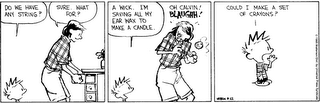
This post is not suitable for those with delicate sensibilities. I just love today's Calvin & Hobbes cartoon! Just in case you have trouble reading/opening it, Calvin is collecting his ear wax to make a candle and, when his mother expresses disgust, he suggests crayons as an alternative. While I fully understand Calvin's mother's reaction, to me this cartoon typifies the gradual way in which adults impose limits on creativity.

We all know that "kids say the darndest things", but how do we handle it when they do? At least Calvin's mother didn't have to share this moment with the general public! I remember as clear as if it were yesterday, one of my sons (please tell me he doesn't read this blog) standing on a chair in Macdonalds (other heart attack factories are available ;-)) and announcing very loudly "I made a fart!". It was one of those parenting moments that happens to us all - we know it's going to happen and yet we're still completely floored when it does. Sadly, our attempts at gentle, mature, wise handling of situation were completely ruined by the fact that we were weeping with laughter and utterly unable to get the words out. Yeah. That was going to discourage him from doing that again. That was going to instill an understanding of propriety. Sure. Right.

When I was studying teaching methodology at college, we looked at this very subject and one of our text books (I would love to reference it properly, but can't for the life of me remember anything about it - it was over 20 years ago, after all!) contained an anecdote related by a school inspector:

He was visiting a class of 5 year old children who were engaged in a project of drawing their homes. Most of the kids drew the usual box with a red roof, smoking chimney and cottage windows. One child had drawn a series of connected boxes that seemed to make no sense at all until she explained that it was an aerial view of the house with the roof removed (a budding architect?). "There's my room, there's the baby's room, there's Mommy and Daddy's room, and there's the bathroom with Mommy on the toilet." The teacher blushed. "I don't think so," she laughed nervously and tried to persuade the child that the picture represented something else altogether. After a while the child, showing remarkable insight, realised that the teacher was uncomfortable and sought to put her at her ease, "Oh it's alright," she said, "the door's closed!" The inspector experienced regret that the teacher had focused on propriety and her own sensibilities, rather than the child's display of cognitive ability, creativity, imagination, perspective and the rest of a long list of skills.

When I was a student, I taught drama part-time to pay the bills. My youngest group was 5-6 themselves. Some of the anecdotes these little ones related and the improvs they did were very revealing of details I'm sure their parents would far rather have kept private. I was only 19, so I'm sure I blew it repeatedly, but today's cartoon reminds me that children's imaginations are not restricted by what is "proper", and both teachers and parents need to handle the situation gently to ensure that, as they come to terms with acceptability, they do not experience a sense of condemnation of their efforts and, by extension, themselves.

And are we so very different, we adults, with our maturity and perspective? We pour our hearts and souls into some or other effort which the client then proceeds to rip to shreds. Do we not feel those criticisms as if they were of ourselves? No? Just me then!


Friday, August 18, 2006

Wikipedia - an inherent risk

Via George Siemens, here is a wonderfully ironic tale about Wikipedia. To summarise: Dave Snowden amended the entry on Knowledge Management, including references to some of his own work, only to have his amendments "corrected" by someone (he has dubbed Clint) who asserts that he (Snowden) has never read Snowden's work.

Whoops. The words egg and face come to mind. I can't help hoping that this little tale finds it way back to "Clint" (although, being an opinionated old bat, I have been in his shoes more than once), not because of schadenfreude, but so that he can adjust his own understanding and allow Snowden's amendments to stand.

This tale highlights an inherent risk of resources like Wikipedia (and any social media) - as Snowden says "Clint has more energy for this than I do". People with the time, energy and inclination will get their take on things out there more often and more "loudly" than those who might have a more accurate understanding but who, for whatever reason, don't avail themselves of the forum as assiduously.

In this week's summary email, George says: "Wikipedia is essentially encouraging "critical thinking"". Without this critical thinking, we might be inclined to accept Clint's take on knowledge management and subscribe blindly to his view that Snowden has never read Snowden's work. Increasingly, the onus is on us to double check our sources and find corroborating evidence of claims made. We can't afford to hide behind "I read it in Wikipedia, so it must be true".

Thursday, August 17, 2006

Did you know?

Via David Warlick, this post from Karl Fisch, containing an interesting PowerPoint presentation of "did you know" type facts. It makes for interesting viewing, even just from a fact-collecting perspective, but it's the sort of information that should be having an impact on the way we address learning in general, and education in particular. The sequence of slides that I found most telling was:

  • The top 10 in-demand jobs in 2010 didn't exist in 2004
  • We are currently preparing students for jobs that don't yet exist...
  • Using technologies that haven't been invented...
  • In order to solve problems we don't even know are problems yet.

Wednesday, August 16, 2006

Learning by doing

I came across this review on Educause recently of a book that glories in the pithy title of: Learning by Doing: A Comprehensive Guide to Simulations, Computer Games and Pedagogy in e-Learning and Other Educational Experiences. The author is Clark Aldrich, and the publisher John Wiley and Sons (2005). The review (by Deborah Keyek-Franssen - a new name to me) is well written to the point that I would like to get my hands on a copy of this book, but find the price tag a little prohibitive.

I have to say that I am already convinced of the pedagogical value of games and simulations. What I am currently looking into is their andragogical value (although I get the impression that the word is falling into disuse and that pedagogy is becoming the generic term covering both bases). I have been toying with the notion of inlcuding games/simulations in a blended learning solution for adults, but many of the simulations I have seen are somewhat trite (mind you, the same can be said for many of the quizzes on e-learning materials). I realise that any game/simulation will have to be both engaging and effective. At a recent conference, one of the speakers expressed the view that games and simulations should afford the opportunity to put the learning into practice or to assess learning, and should not attempt to teach. I thought this was an interesting viewpoint and one that may well have some validity for an adult audience. However, I'm still just at the exploring stage. Much remains to be seen.

In the meantime, I shall have to see if my library has seen fit to acquire a copy of Aldrich's book.

Tuesday, August 15, 2006

Book meme

I haven't traced it all the way back to the start, but Barbara Ganley and Chris Sessums are involved in a book meme, which is quite revealing. It puts me in mind of Kathy Sierra's excellent and thought provoking post some time back (12 Feb, to be exact) about what was on her virtual coffee table. Kathy writes as I imagine she speaks, so I had felt as if I knew her pretty well for some time, but that list of books was the clincher. When you know what a person reads (and why), you know an awful lot about a person. While Kathy came up with a list of her favourite books in no particular order, the meme that Barbara and Chris are contributing to is structured, and I can't decide whether that makes it easier or tougher.

Their challenge looks like this:

  1. A book that changed your life
  2. A book you've read more than once
  3. A book you'd take to a desert island
  4. A book that made you laugh
  5. A book that made you cry
  6. A book you wish had been written
  7. A book you wish had never been written
  8. A book you're currently reading
  9. A book you've been meaning to read
  10. Tag five people you want to hear from
It's a thought provoking list, rather like one of those ice-breakers where you are asked to list five people (living or dead) you would like to have around your table at a dinner party. I'll be interested to follow this and see where it goes and what it reveals about the people I read. Ooh - that sounds a bit voyeuristic, doesn't it? I feel a bit like a snoop, now!-)

Learning while under fire

There's an interesting post from Mark Oehlert today about soldiers on active duty learning and adapting in order to stay alive (and presumably try to win the conflict). He links to an article on the FCW website. This harks back to an earlier post of mine about learning under pressure, and to a conversation I had with Vicki Davis on one of her posts.

Monday, August 14, 2006

Back to the grindstone

I have been away from work for a week, having a little break. Our boys were away at a youth camp wth 5000 other teenagers, so my husband and I went to a B&B in Cambridge (a mere 1 hour drive away) for a long weekend's R&R. We left our laptops behind, so we could unplug and unwind. When the boys returned from the camp, we spent a few days together as a family, which was really great. With the recent disruption to the flights out of the UK, I am only too pleased that we didn't try to do anything more adventurous or exotic.

Today, I got back to the office and online. Of course my Bloglines hadn't been on holiday, and there were more new posts showing there than there were new emails in my Inbox. I haven't even bothered thinking about what that says about the balance of my life!

Of course, I couldn't read them all properly, but was grateful to rate a mention from Stephen Downes and a complimentary shoutout from Vicki Davis in my absence (actually, Vicki's post focuses on the value of comments on blog posts, and is well worth the read, especially for new bloggers). I skimmed through the list of posts, skipping several , scan-reading some and slowing down to read a few. I identified that Blackboard's patent is still causing waves. I have downloaded Stephen and George's discussion for a listen when I get my head above water (they will no doubt go way beyond my fighting weight, but it'll be a stretching exercise for me). I briefly toyed with the idea of taking up Will Thalheimer's challenge to "prove that taking learning styles into account in designing instruction can produce meaningful learning benefits", but decided I have neither the time nor the resources.

A final note: During my week off, I seem to have gained another subscriber albeit a private one, which gives rise to a question: what would be the sort of reasons that a person would choose to be a private subscriber? It's not meant peevishly - I'm genuinely curious. Maybe you have a few ideas. Maybe you're one of the private subscribers and would be willing to share your thoughts (anonymously of course, if you prefer). I think it would deepen my understanding of the levels of participation and consumption of the blogosphere.

Friday, August 04, 2006

Go Kathy!

Kathy Sierra has posted her protest against the gender label being attached to female bloggers. I am delighted that someone of her standing has taken this stand. I touched on this point myself a while back and brought down upon myself the well articulated ire of Josie Fraser (here and here). But I'm still with Kathy: the blogosphere is one place where I don't need any "special favours" as a woman, as she says:

The tagline I've used on and off over the past 15 years to indicate how lucky I feel about being in a profession (and in a country) where gender is not nearly as important today as it once was (and yes, I'm extremely grateful for all those who fought to make this happen):
The post has attracted a flurry of comments which make interesting reading.

Thursday, August 03, 2006

Calvin and Hobbes: it was bound to happen

More than once, I have linked to a Calvin and Hobbes strip in this blog. This has long been one of my favourite cartoon strips. People tell me it's because it mirrors my own experience with my sons. In defence of my kids, I would dispute that... although my elder son at the same sort of age was prone to an alarmingly adult (in the clean sense) turn of phrase.

A while back, I posted this idle thought that the strip would make a good basis for a dissertation on teaching and learning. Sadly the link from the post no longer accesses the cartoon that sparked off the train of thought, but, somewhat belatedly, I got an anonymous comment pointing to this blog. Which just proves that I'm not as original or left-field a thinker as I'd like to believe!

Blackboard, oh dear!

I've been on leave for the past three days and, while the whole Blackboard patent thing had kicked off before I left, it certainly gathered momentum during my absence. So many people have blogged about it that I won't even try to list them all here. I certainly wasn't even able to read all the posts on the subject today. What worries me about this sort of thing is the dangerous ambiguity and the myriad loopholes.

Recently, a far smarter colleague than I went through the business of trying to nail down exactly where the parameters fell surrounding the whole Moodle copyright issue. I read through his correspondence and gave up trying to understand what was going on. It seemed to me to be full of contradictions and I just knew I would wind up contravening one clause as I tried in my blundering way to comply with another. I was somewhat vindicated when he said he was just as confused, but that didn't solve our problem. I recognise that Blackboard and the Moodle guys aren't going to be interested in prosecuting the little fish, but I work for a Big Fish and it's important that the solutions we offer our customers are all legal and above board. I can see myself avoiding anything that is even remotely in danger of bringing a lawsuit down on our (clients') necks, severely restricting the breadth and depth of the sort of solution that we might otherwise have offered.

How sad. Why can't we all just get along?

Friday, July 28, 2006

Learning portals

Some time ago (22 June, in fact), I posted a comment on one of Harold Jarche's posts about the pressing issues of adult learning. Tony Karrer repsonded with a request that I post that comment here, saying "It took me about five posts to say what you just said in about 20 words!". How could my ego resist such a flattering request? So here (somewhat belatedly) it is:

I find that the learning I design these days is looking increasingly like a knowledge portal and less like a course. It’s the putting-life-on-hold thing that makes learning inaccessible to so many busy professionals.


The virtual/RL line blurs

Mark Oehlert has a post about buying a real book in a virtual world with virtual money. I had to read it twice before I figured out how it works, and I'm still not completely sure I've got it right!

Years ago, when Dungeons and Dragons first came to prominence, a story did the rounds about a bunch of students who played this game so much that they became both obsessed and sleep deprived and lost track of the line between the virtual world and the real one. One the players allegedly murdered his parents in RL as a way of accessing his inheritance in order to do/acquire something in the virtual world, having completely overlooked the fact that the RL money (had he got it instead of prison time) could not make the transfer into the virtual world (real money won't buy you that hotel on Fleet Street in a game of Monopoly, either). The story might have been entirely apocryphal, but it was used by many parents to encourage their kids to balance their RL/virtual world experiences.

And here we are, a few years later: buying real things with virtual money.

Plotting relationships

A colleague sent me a link to two sites today, aimed at plotting the human side of relationships online, by contrast with Technorati and Feedster, which plot the "mechanical connections between nodes".

The first of these is called XFN, which stands for XHTML Friends Network, and uses as its starting point, this quote from Tim Berners-Lee:

The web is more a social creation than a technical one. I designed it for a social effect — to help people work together — and not as a technical toy. The ultimate goal of the Web is to support and improve our weblike existence in the world. We clump into families, associations, and companies. We develop trust across the miles and distrust around the corner.
It allows individuals to identify the nature of their relationships with those who appear on their blogroll and accommodates the fact that relationships may not always be symmetrical (for example, I may think that you're my friend, while you may view me as an acquaintance.

The second of these is an online presentation called Bridging XHTML, XML and RDF with GRDDL (Gleaning Resource Descriptions from Dialects of Languages).

I'm not sure to what extent the untidiness of human relationships can successfully be defined or plotted within the tidy structures of code, but I'm wading my ignorant way through the material, hoping that it will dawn on me. I'm sure the more technically competent bloggers will make far more rapid progress with the material than I am, and I'd be interested in the thoughts of those fluent in the various MLish dialects.

Thursday, July 27, 2006

Too much connectivity, on the other hand

Via George Siemens's weekly blog summary email, I found this article about "homo conexus", the connected man by James Fallows. He spent a period of time living and working entirely online. He made some interesting discoveries and experienced some frustrations along the way, which he sums up in his last two paragraphs:

In practical terms, where does this leave me? With the experiment over, I doubt that I'll use Writely again. (Yes, it does most of what I want in a word processor -- but so does Word, and I can use that when I'm sitting on an airplane. Same for Google Spreadsheets versus Excel.) Maybe I'll check out YouTube when someone sends me an interesting link. I'll look at Wikipedia pages when they come up high in a search and I have a way to double-check any crucial facts. As for MySpace -- nah!

But other applications have come to seem like natural parts of my daily life. Google Calendar is worth the effort -- for the appointments that my wife needs to know about. I find that I leave Google Earth running all day, to check aerial views of a foreign site I've just read about or a neighborhood where I'm meeting someone for lunch. The discount travel broker Kayak has gotten my attention; eBay has retained it, for all the obvious reasons. Flickr is a good way to share photo files with my family -- and keep them from jamming up my computer. I'll continue using Gmail as a backup site for important data files. As Ajax-enabled sites spread, they'll make sites that still require you to hit "refresh" or a "submit" button seem hopelessly out of date. I still don't like the label Web 2.0, I will continue to mock those who say "mash up," and I will never use Dodgeball. But I'm glad for what this experiment has forced me to see.

I don't know exactly how old Fallows is, but he has kids in their 20's, so I estimate that he must be at least knocking on 50 - more or less within my own generation. I would be interested to see the experiment repeated with a digital native. I wonder how their experiences would compare. Would their frustrations be the same? For example, would a 20-year-old be frustrated by the fact that Writely can't be used on an aeroplane, or would they use that time to catch up with a few downloaded podcasts?

Wednesday, July 26, 2006

Connectivity: ah, this is the life!

Today, I am working in my garden. I have an extension cord to take care of the power supply, wi-fi to take care of connectivity, a sun umbrella to take care of the glare on the screen, a glass of lime Coke (other beverages are available:-)) to take care of the heat and the thirst, and I'm "in the office".

My laptop is on the patio table, back to back with my husband's (he's on leave, but he's trying to resolve a problem in the New York office). The boys are indoors, playing on their PS2, the cats are rolling gleefully on the flagstones. The neighbours' kids are swimming in their pool, making delicious splashing sounds. The garden smells strongly of the conifers my sons were trimming back yesterday. Drifting in from next door is the tantalising aroma of another neighbour's cooking (I think the wife is Thai, and the smells from her kitchen would back that theory up) And in amongst these sights, sounds, smells, tastes and sensations, I am unravelling the intricacies of a system for which I must design learning materials. Life is sweet indeed.

As I look back over the career path that has led me here, I contrast this working experience with that of being considered late for work if I forgot to sign the register before 8:30 (regardless of what time I actually got into the office); with that of being expected to be in the office while authoring a user manual, in spite of the distractions that slowed down my work rate. I know that this always-on connectivity has brought with it many negatives (such as those my husband is experiencing as he spends a day of his precious, well-earned leave in discussion with staff in London and New York), but, for today, my experience is purely positive.

Contented sigh.

Tuesday, July 25, 2006

Virtual characters in elearning

Thanks to Mark Oehlert for this heads up. Codebaby offers a virtual character solution to add interactive, animated characters to elearning materials. They are quite sophisticated. It might be worth a look - some of our clients may have an interest in a feature like this. I haven't been able to identify what breadth of range is available. So far, I have only encountered female characters, and they have all had very strong North American accents. I presumed male characters could also be created, but I had less confidence that different accents were on offer. A UK audience is likely to baulk at an American/Canadian character presenting their learning material - particularly in the public sector.

Running through their online seminar, I learned that the customer decides on the gender and design of the character and can either choose or supply the voice. This takes care of all the variables that bothered me. However, that leaves one fairly large obstacle. Distance. I wonder if there are similar offers available in the UK.

Monday, July 24, 2006

Online whiteboard

Thanks to Mark Oehlert for this steer.

I am smitten! General Electric has developed an online whiteboard that I can use and share with up to two others. I can see this coming in very handy when next I have to discuss some "look and feel" issue with someone over the phone. So we can discuss our ideas, drawing on this whiteboard all the while. Then, when we're done, we can print it out. This is just so cool.

The one thing I haven't figured out how to do yet, is erase something. Perhaps there is a tool for that, and I've just missed it.