A personal note today.
Today is Christmas. As a Christian, it should be a day that brings me joy. But I heard this morning that a friend lost her battle to cancer on Friday. She was only 33. I don't know the answer to the questions these situations pose, but I am profoundly glad to have had the privilege of knowing her!
How tough for her family that everyone around them is celebrating and partying while they grieve - it must make them feel even more alone in their grief. No doubt every Christmas season from now on will have that little seed of pain. Twenty years ago, my Gran died in the early hours of 19 December (my birthday is 18 December). Her funeral was held on my mother's birthday (21 December). I am familiar with grief of this sort. At least, however, my Gran was a grandmother. Sarah never even got to be a wife and mother. Not that I'm suggesting that this is the only path the fulfillment for a woman, but (a) it is an indication of how short her life was that she never had the chance and (b) it was a path she wanted to walk - she often spoke of her wish to meet someone special.
To everyone out there for whom the Christmas season contains a note of sadness, may you know peace this year.
Monday, December 25, 2006
A sad Christmas

Friday, December 22, 2006
I'm legal
Just thought I'd share. After 6 months of waiting and phoning and fighting and nagging and being stonewalled, I finally got my permanent residence permit (more correctly known as Indefinite Leave to Remain) on Saturday. It was well-timed as an early birthday present (that was on Monday). It's a huge relief, but the process is ridiculously out of keeping with the requirements of a modern family.
My application was based on the fact that my husband is an EU (European Union) citizen. As a consequence, I had to submit his passport in suport of my application, together with my passport, our original marriage certificate, a letter from my employer, a letter from his employer, four recent payslips of his and four of mine.
The problems started when my husband needed to travel. As the head of IT for a multinational company, he often needs to travel at the drop of a hat. New York, Paris, Carpi... Of course, this means that he needs his passport. Quickly. The process of "urgent" return of documents at the Home Office takes a mere 10 working days. They got very sick of us insisting that we needed it NOW, and my husband had to make many trips to their offices to collect the thing in person.
I can (just about) accept that, as the applicant, I would have to put up with some disruption to my life, and fortunately my job doesn't entail any international travel at present. But why my husband should have endure this nightmare is a mystery to me. Surely we couldn't have been setting a precedent? Surely there must be others in this day and age who travel extensively and who cannot be without their passports for 6 months? Surely!
Since his passport didn't actually need to be stamped, I couldn't understand why they needed to retain it at all. Why didn't they just record the fact that it had been seen and return it to him? In the end, in frustration, we paid £80 to the Swedish embassy for a provisional passport for him and submitted that with my application, while he used the original document.
But what if I had been the one with the jetsetting job? What then? I mean, they can have the payslips and stuff for 6 months if it makes them happy, but the passport thing needs to be reworked to fit in with the realities of life in this age. Surely we have the technology to achieve this?
I was planning to apply for citizenship next year, in order not to have to separate from my family in airports in the future, and not to be the only who has to apply for visas every time we want to go anywhere. But if it means being without my passport for another 6 months, perhaps I'll pass...
Thursday, December 21, 2006
The king is dead?
Thought provoking post from Scott Karp on the subject of content. Don't miss the discussion going on in the comments. As is so often the case, that's where the debate really unfolds.
In my sector, there are still those who proclaim that "content is king". I'm still coming to terms with my right to disagree with boffins, even though I'm just li'l ol' me. I have a kneejerk tendency to assume that I am mistaken when someone I respect makes a categorical statement about the industry. Last time someone used that phrase I felt very uncomfortable - they seemed so sure of themselves, but I didn't agree. I let it go on that occasion, but am relieved to see the argument seeing daylight here.
Of course, the content of learning resources has to be reliable, valid, etc. But as I see it, there are loads of people who can produce content. Good content. Naturally, I believe that my team and I are among them. Maybe it's because I'm a learning designer that I believe what makes a client go with us rather than a competitor has more to do with design than content. Is it pitched at the right level(s)? Does it cater to the range of users? Is the layout easy on the eye? How intuitive is the navigation? Is the user in control of his journey through the content? How easily will he find what he is looking for? What external/internal/human resources are placed at his disposal? Are there multiple ways in to the content? Is it engaging? Are there opportunities for interactivity? All that stuff...
There are many, many organisations out there producing learning resources. It's a tough market. I agree with Scott that, if we want to grow - in fact, if we want to survive - we will have to do far more than produce good content. Otherwise, our users are likely to stick to Google and wikipedia...
Tuesday, December 19, 2006
Tagged!
Harold Jarche has tagged me with the five things meme. This is a first for me, and I'm not sure how to feel about it. I have read some memes with more interest than others - this is one that gives a bit of trivia-style glimpse into the people behind the blogs. The idea is to give 5 little-known facts about oneself. Since I've met only one fellow blogger before (and I won't tag him because he wouldn't thank me for that!), I could take refuge behind things like my height and eye colour, but I won't...
- I have a thoroughly normal 21st century family: a sister, a step-brother, a step-father, a step-mother of roughly my own age and a half-sister who is only 12 and is younger than my own children. She and I have only met once - at our father's funeral. By contrast, my children are unusual among their peers, growing up in what used to be a normal family: both parents still on their first marriage and in no danger of quitting.
- I am a deeply committed Christian.
- My paternal grandfather won the battle in north Africa single-handedly. I know this from the stories he never stopped telling, and in which he was always the hero - it seems he achieved more in those scant years than most people would do in 5 lifetimes... Monty was most fortunate that my grandfather wasn't on Rommel's team !-)
- I am married to a Swede, and can speak the language a little. I am better at reading it than I am at conversing, but when conversing, I cope much better with the clipped accents of the east coast than the glottal sounds of the west. Sod's law - my husband's family is mainly from the west coast. I also speak fluent Afrikaans, a smattering of Zulu and Xhosa and can read Dutch.
- I presented an Afrikaans music TV programme in South Africa in 1988. I was very bad at it.
Doug Belshaw
Vicki Davis
Albert Ip
Jeff Utecht
Wendy Wickham
Thursday, December 07, 2006
The Big Question for December
Over at the Learning Circuits blog, the big question for December is... correction, the big questions for December are:
What are the biggest challenges for you/us as head into 2007?
What are your predictions for 2007?
What will you remember most about 2006?
- The opportunity to create resources that didn't involve linear navigation (wahey!)
- The publication of George's book Knowing Knowledge
- The terrifying (first hand) discovery that many UK primary school teachers are really pants at maths
- Trying to persuade more paying clients to allow us to create learner-driven resources
- Creating learner-driven resources that add more value than Google and wikipedia
- Finding ways to accommodate and even capitalise on the first instinct of learners in the workplace to ask the bloke at the next desk
You know, I don't really feel bold enough to make predictions. I don't know enough!
- I hope that we see more use of ICT in general and social media in particular in schools, and in learning as a whole
- I hope that education authorities the world over start to revise their ideas based on input from universities and employers... especially employers
- I hope that workplace-based learners will become increasingly pro-active in respect of their learning
Friday, November 24, 2006
50 Million Bloggers
I was forwarded a newsletter from ITinfo that included the following article by Dave Murphy:
"Technorati, the recognised blog tracking service, reported that thereIt looks as if blogs are becoming a bit like mobile phones and email accounts.
are fifty-one million blogs were in publication as of today. This is one
hundred times more blogs than were in existence when the tracking
service started, three years ago.
It is estimated, based on Technorati's numbers, that the blogosphere,
the global blog space, is doubling in size about every six months.
One hundred and seventy-five thousand blogs are created every day--two
every second. These aren't blog entires, but new blogs, each with dozens
to thousands of articles. an estimated 1.6 million entries are posted to
blogs each day--eighteen per second. These numbers do not account for
the comments, trackback pings, and e-mail distributions that follow many
of the articles.
While most bloggers post in English--about thirty-nine
percent--thirty-one percent ware written in Japanese. Together, these
languages comprise seventy percent of the blogosphere."
Thursday, November 23, 2006
A stupid question from someone who should know better
Can anyone provide an explanation as to why all my posts these days have the words "writing skills" appended just above the tags? I've look in the template and don't see anything there that explains the mystery...
It's oh so quiet...
It's an odd feeling, this. I have been posting less than usual, due to the fact that I am up to my ears in assignments, a new project and various other commitments. And such posting as I have done has gone utterly unremarked. Even other people's posts on which I have commented have received no other traffic, so my CoComment site has gone equally quiet. I have never been one of the hot bloggers, so my blog posts don't often attract much attention, but this is weird. I feel like the "action" has moved somewhere else, while I've got myself caught in a backwater. I've never been one to post for ratings (although it is gratifying when something I say strikes a chord with someone else), but I didn't realise how much I would miss the inteplay if I ever lost it.
Gary Larson - he of the Far Side cartoon strip (whose request not to have his "children" splurged all over the Internet I shall respect by not trying to reproduce or link to it here) - did a cartoon titled Last of the Mohicans, which shows a lone Native American in a settlement of tipis calling "Little Bear? Running Deer? Where are you guys?" I feel a bit like that.
Did I miss something?
Wednesday, November 22, 2006
Wisdom of crowds get challenged...
Clive Shepherd has posted about David Freedman's oppositional stance on the subject of the wisdom of crowds. I expect that David Freeman is going to come in for a bit of shtick on this one - it isn't PC to say that a bunch of people together can/will act unwisely, in this age when collaboration is the In Thing and can do no wrong. It is interesting to hear the voice of dissent.
I attended a workshop about James Surowiecki's Wisdom of Crowds some time age, and posted on it at the time. I have to admit that, the whole way through the workshop I was picturing those thousands upon thousands of people listening to Hitler speak and hanging upon his every word, and football crowds running amok, and Lord of the Flies (okay that last one is a work of fiction, and the group might be a little small to be called a crowd, but I pictured it anyway). I couldn't make those images fit with what I was hearing.
I can understand that under certain circumstances, crowds can be said to behave wisely. The 1994 elections in South Africa were a prime example: 90% of the country's population was getting to vote for the very first time. The world expected violence and bloodshed, but what happened was a peaceful, incident-free election.
This was a one-off situation when people consciously decided to strive for what was best for everyone. I fear, though, that the belief that crowds always display more wisdom than individuals is built upon the insubstantiated notion that people - individually and collectively - are always (whether intrinsically or extrinsically) motivated to do right and be the best they can be, and that this driver increases exponentially when people gather together. I have yet to see evidence of this. Many, perhaps even most, people strive to do the best they can for themselves under the circumstances, but doing well and doing good don't always go together... unfortunately.
In a post some time ago, I wailed half in jest: why can't we all just get along, to which Harold Jarche supplied a one-word explanation: greed. For as long as this is the case, I wonder how wise we really will be - collectively or individually.
Saturday, November 18, 2006
The open hand
When we play cards, the idea is to keep secret from our fellow-players the hand we hold. Not long ago, the same was true of the knowledge we "owned". While card playing hasn't changed much, we have moved to a more generous age in relation to our learning.
Recently, I travelled through to the university campus where I am studying in order to facilitate a mini-clinic in online discussions.
To put this into context:
I don't think I do them a disservice to say that most of my classmates are in their 40s and 50s. There are one or two who may be older, a fair few in their 30s and a mere handful in their 20s. So the class is not exactly overflowing with digital natives! Some of them are still on the fringes of using ICT and one (a classical ballet teacher) had never sent even sent an email message before. One of the requirements of the current module is a certain degree of participation in online discussions. For a few members of the class, this was unknown and scary territory - a place on the map left blank and white and labelled "Heere be dragons
We who inhabit the blogosphere are accustomed to holding our knowledge with an open hand, and having easy access to the knowledge of others, as if playing a game with our cards on the table for all to see and use. Because they do not inhabit the blogosphere, however, my classmates (while grateful) were taken by surprise at my suggestion, and I realised that, a short while ago I might have reacted in much the same way.
It filled me with a renewed gratitude for this community to which I now belong. I have learned so much (and continue to learn, even though I have kept a rather low profile lately, due to time constraints). After even this short time (just over a year), I can't conceive of life without access to the online community - it would be like sensory deprivation.
Wednesday, November 15, 2006
Writing skills
Brag moment: my 13 year old nephew won an award for this poem. It's called "With these hands" and the young poet's name is Michael Ihlenfeldt.
With these hands - I could touch the sky
I could leap off the ground
Flap my hands and fly
With these hands I could slow down time
I could alter the weather
By simply clapping them together
With these hands I could hold back the rain
I could light up the sun
I could let rivers run
With these hands I could soothe the pain of the nation
I could dry up their tears
Remove all their fears
With these hands - I can do wonderful things
If, deep in my soul
My faith keeps me whole...
Of course the poem is what it is, with a readership or 1 million or none at all, but I wonder if it would have made a difference if he had posted the poem on a blog. When he was advised that he had won the award, he couldn't remember what poem they were referring to (perhaps he writes many such pieces!). I have read so many wonderful blog posts about how kids have been affirmed by having people comment on their work when they have posted it online.
Wednesday, November 08, 2006
The future of learning design models
Over at LCB, the Big Question for November is about the future of learning design models (such as Addie, ISD and HPT).
Hmm.
My background has chiefly been in corporate learning and my interest is largely learning in the workplace. In this realm, these models have been very popular and, in some situations, such as technical skills, very useful.
A while back, there was a conversation about whether ADDIE had in fact become DI, and I have worked in organisations where that has been the case: talk about grindingly frustrating! At all costs, we need to avoid that, since the learner's needs are completely ignored. Whether or not we use models, my view is that the learner's needs and the learner experience should be at the heart of what we do.
As I said in a conversation some time back, I suspect we are going to become more and more like the designers of cars: we will provide all the features - it will be the learner who takes the driver's seat and decides where to go, when to go there, how often, how fast and by what route. However, some method still needs to be applied to decide what features to provide and the look and feel of the vehicle -if we are completely without strategy, we are likely to wind up with a resource like Homer's car that includes every feature imaginable, but is hideous to look at, impossible to use and completely outside of everyone's price range.
Tuesday, November 07, 2006
Happy birthday, Robyn!
Today is my sister's 40th birthday, so I am going to indulge myself with a personal post today. Like many of us, she is trying to convince herself that there has been a gross miscalculation and that she is, in fact, only 39 today. What she doesn't realise is that her milestone birthdays are even worse news for me than they are for her: she is my younger sister, after all!
The idea had been for her to come and spend two weeks with me in the UK at the end of October. This was to have been my gift to her, since (like most of our compatriots) she has never travelled outside of South Africa. She has also never seen autumn - South African trees are mostly evergreens and there isn't really an autumnal period there. But she was unable to come. So I decided to try to send autumn to her. England is very pretty in October - at its prettiest for my money. Photographs are a poor substitute for the real thing, and (unlike Stephen Downes) I'm no great shakes with the camera. However, for what it's worth, I don't think she'll mind sharing this part of her birthday gift with you.
Happy birthday, Robs. I miss you.
Tim Berners-Lee sets the record straight
There are times in life when it galls me to be proved wrong. Then there are those times when I am delighted to have one of my negative perceptions debunked. This is one of those times when I am happy to have been wrong.
A while back, I posted about an article on Tim Berners-Lee and his view of Web 2.0. His reported reaction disappointed me deeply. However, it seems he was taken out of context, and he has used his own blog to set the record straight. Hat tip to Vicki Davis for the link.
Friday, November 03, 2006
Juggernauts and handbrake turns
Interesting post today from Kathy Sierra (one of my all-time favourite bloggers). She's exploring the relevance of the sort of skills imparted in science courses - comparing what is taught to what skills are actually exercised in these fields. This subject has traction and has been explored from various angles by numerous people across a wide range of disciplines. I have to agree with some of the comments that the problem is not unique to the USA. I have been directly exposed to the education systems of two countries (UK and South Africa), and via the blogosphere have vicariously encountered concerns surrounding the Canadian, US and Australian systems.
Recently, during a Learning and Teaching lecture, we were exploring the concept of PLEs in schools. I posted recently on this point, but the lecturer advised me that the matter was receiving attention from on high.
While these are two separate issues, I think they suffer from the same limitations: the bureaucracy and red tape associated with state education systems. We have recognised the changes that need to be made. We know what direction should be going in, but the turnaround time is frustratingly slow. After all, government departments are akin to juggernauts and don't do handbrake turns very well. Perhaps we need to be looking at ways to restructure the education system to improve response times. For all I know - perhaps "we" already are, but that's yet another juggernaut turn. Maybe what we need is a streamlined, nippy little system like the Minis in "The Italian Job".
I wish.
Tuesday, October 31, 2006
Assessment in the collaborative learning environment
I just had to store this somewhere. I am reading an extract from Building Learning Power by Guy Claxton (2002) and this quote jumped up and smacked me in the face. It made me want to rush out and shove it under the nose of all the decision makers associated with secondary school assessment in the formal education sector (the bold formatting is mine):
If the good learner is the essentially the person plus their resources (and their ability to draw on them), our methods of testing should encourage teachers and students to value and practise capitalising. In today's world, it makes as much sense to sit 15-year-olds down at solitary desks and ask them to display their knowledge and skill as it would to take away David Beckham's football and tell him to perform.I would go one step further than Claxton's closing words of this paragraph. I would reword it to say "... David Beckham's teammates and tell him to perform." Even the most brilliant player of a team sport cannot defeat the opposition on his/her own. We make new discoveries, conquer new horizons, meet new challenges together. This is reality.
Oh, and by the way...for those outside the UK, David Beckham is an English football (soccer) player - about the best known player in the world in 2002, in fact some would have said the best player in the world, period. In 2006, in his early 30's he is something of a fading star, but he still knows a thing or two about kicking a ball about the place. His appeal may also have a little something to do with the fact that he is... erm... easy on the eye.
Saturday, October 21, 2006
Why young children are not ready to be in control of their own learning
 I know it's just a cartoon, but today's strip illustrates why I don't believe that young children are in a position to direct their own learning journey. There are things they need to learn that they simply are not in a position to know that that they need to know (sorry - clumsy sentence!). They simply do not have the perspective or experience to be able to identify vital knowledge. The adults charged with the care of a child must assume responsibility for making those choices until they are ready to do so themselves. Ideally on a gradually diminishing basis. Adults have passed on knowledge to the next generation for thousands of years. In some cultures even to this day, survival depends on attentive absorption of this learning.
Of course, we will make some misidentifications, of course we will adopt some dire methods. As a race, we seldom get things absolutely right. But I don't think these errors are enough reason for us to abdicate this responsibility - it's part of the nurturing process.
Or that's what I think, anyway.
Wednesday, October 18, 2006
Minnows and whales
A comment from Graham Wegner on this post from Kim Cofino got me thinking. As I commented on Kim's post (with a few edits):
We each seem to see ourselves as minnows among whales. My perspective is that I’m just li’l ol’ me conversing with the great and the good of the blogosphere. Graham obviously feels the same. He and I covered this ground once before when he referred to his home as being ordinary Adelaide and I mentioned that to some of us, Adelaide was exotic. One man's ho-hum is most decidedly another man's "wow!"
I wonder of any of those that I think of as being the great and the good think of themselves as li’l ol’ me. It seems this medium has engendered a strong sense of mutual respect, while still being a great leveller. I humbly appreciate the opportunities to engage with the likes of Tony Karrer, David Warlick, Mark Oehlert, Harold Jarche, Vicki Davis and, now that I’ve thought about it, I can just picture them reading this post and going: “Who, me? But I’m just…”
On the blogosphere no-one seems to be “just” anything. So here's to us, minnows and whales all.
Tuesday, October 17, 2006
Managing Organisational Change
As the designers and developers of blended learning solutions, my team often gets involved in supporting clients through periods of organisational change. We find them to be at varying stages of preparedness and with a varying grasp of the implications and requirements of the change process. Understandably, there's a lot of "we don't know what we don't know" going on. As a consequence, they are often not sure what mechanisms need to be put in place to ensure successful transition.
This week I am participating in an online VLE conference and I came across this graphic on a slide in a presentation by Philip Butler (Senior e-Learning Adviser for JISC's London RSC) - apparently it originates in the States with someone called Andrew Williams (new name to me). So hat tips in all the right directions.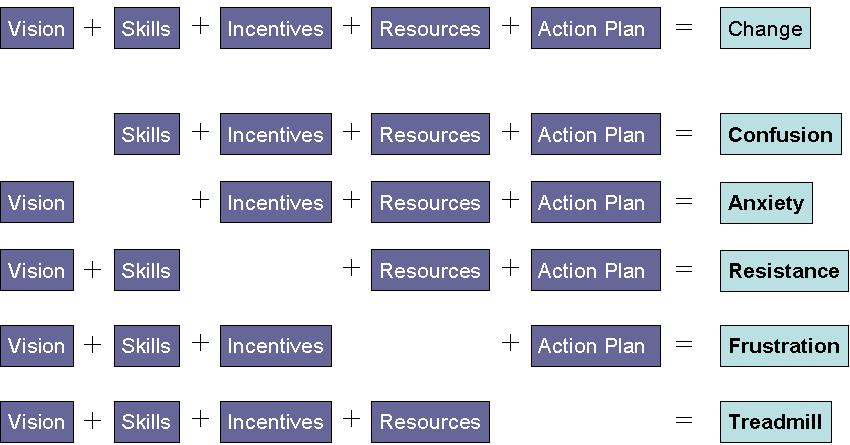
At first I thought it was just a bit of glib rah-rah stuff, but as Philip unpacked it in his presentation I realised how much good, solid sense it made. It had obviously been well thought out. This is the sort of thing that needs to be converted into a poster for some people's office walls, and taped to a few mirrors.
If your organisation is going through change at the moment: adopting a new LMS; going Web 2.0; getting to grips with teaching-with-technology, and struggling a bit, I recommend that you have a look at the diagram and identify the missing piece(s).
Sunday, October 15, 2006
Ardent student
I realise I haven't been posting much here in the past week, but I haven't been idle. My thoughts have predictably been focused on issues around my learning materials for my Master's degree course. Rather than bore you silly with stuff related to my course, and also with a view to encouraging my classmates to get bloggin' I've created a new blog for these reflections. I opted for edublogs, since most of my classmates are teachers and edublogs seem to offer a lot that would be helpful to people in the teaching profession. The blog's name (Ardent Student) is due the fact that I acknowledge that I am an utter learning geek - what the British call an "anorak". Already, Tuesday evenings have become something I look forward to, in spite of the fact that it adds pressure to my already full schedule, and I really get tense about the fact that I have so much interesting reading to do and so little time to do it in. I find myself reading recommended texts after midnight when a more sensible person would be pushing Zs.
By contrast, I was supervising my 13 year old son's homework a few days ago. The material that he was working on was fascinating. I found it very easy to get caught up in it. But what about my son? Was he ardent? Was he enthused? Not so's you'd notice. I commented to my husband later that teachers really seemed to make an effort these days to make homework interesting, unlike in our day. Then it hit me. My mother would probably have found my homework interesting. The work is interesting to adults because it has been devised by adults.
I don't want to get tangled up in the debate about homework: Good Thing or Bad Thing. I think the principle holds for schoolwork done in or out of school hours. I'm still not prepared to accept that children are ready to determine what they need to learn, but maybe they can help us identify how they could learn it... in ways that will appeal to the child in the equation, rather than the adult. As a student, I have a voice on the course committee. Computer game designers have testers who are children. Systems developers have a user acceptance testing process. Maybe those who devise the curriculum or the scheme of work should adopt the same approach. The child's perspective must surely add value to the process.
Hmm. This one needs further thought.